Build The Benefits of Raised Beds

Raised beds are the perfect way to start your own gardenFruits, vegetables, flowers and shrubs can all thrive in the raised bed environment. The popularity of raised beds is on the rise because of their many benefits – reduce soil erosion, the ease of access to control weeds and pick vegetables, creation of a warmer soil temperature in the spring, plus many more

Follow this guide to learn how to create your own raised bed garden. From the building materials to the vegetables – We dive into everything you will need to create a flourishing raised bed.

Click to Enlarge Image Build The Benefits of Raised Beds Build The Benefits of Raised Beds Infographic by CustomMade

Camping Hacks for Families

Source: Fix.com

Make Your Next Camping Trip a Breeze

Ah, the family camping trip: fun-filled days at the lake or river, restful afternoons lying in a hammock slung between two trees, roasting marshmallows by the fire, and snuggling into cozy sleeping bags at night. At least, that’s what glossy magazine covers and campground brochures would have you believe about the experience. If this idealized version of events doesn’t exactly mirror your own camping experiences, you’re not alone. My first few excursions into the great outdoors with my kids involved more work than play, more chaos than relaxation, and far more dirt (on everything) than I bargained for. In the years since, I’ve learned some tricks of the trade that have turned my camping trips into (almost) the postcard version.

Want to ensure that your next camping trip is relaxing, stress-free, and focused on the fun, not the chores, in the outdoors? The following camping tips will ensure more time in the hammock and less time over a camp stove.

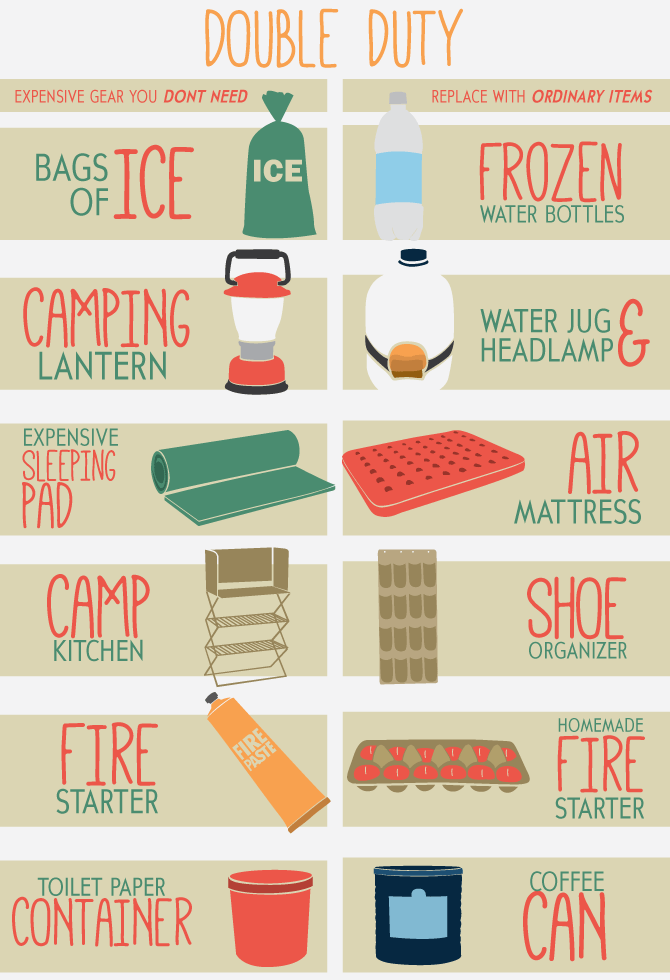
Double Duty - Make your next camping trip a breeze with these fun hacks for families. We'll help you save time, space, and money with these tips for easy camping with children.

Simplification is the key to creating a relaxed camping atmosphere. Reduce clutter around the campsite and shorten your packing list by bringing a few ordinary objects that can double as useful camping tools.


  • Instead of hauling bags of ice (and dealing with the mess), freeze plastic water bottles and let them slowly melt, first cooling your food, then ensuring hydration.
  • Skip the bulky camping lantern: instead, simply wrap a standard headlamp around a clear plastic water jug. It will light up the entire picnic area for games of cards after dark.
  • No need to bring sleeping pads and water toys. Sleep on plastic blow-up air mattresses that can go straight from the tent to the lake. Float on them during the day (or take a nap!), then return them to the campsite each night.
  • Don’t buy an expensive camp kitchen set. Bring a hanging shoe organizer to store camp kitchen supplies, such as spices or grilling tools.
  • Why buy fire starter or chemical-based gel? Use dryer lint as your fire-starter: simply save lint in cardboard egg carton pockets, pour wax over each pod, then bring along to start your fire.
  • If you buy coffee at home, there’s no need to buy a toilet paper roll container. Store toilet paper rolls in your empty plastic coffee containers (the big ones work best). The toilet paper will stay dry and be easy for kids to find when they need it.


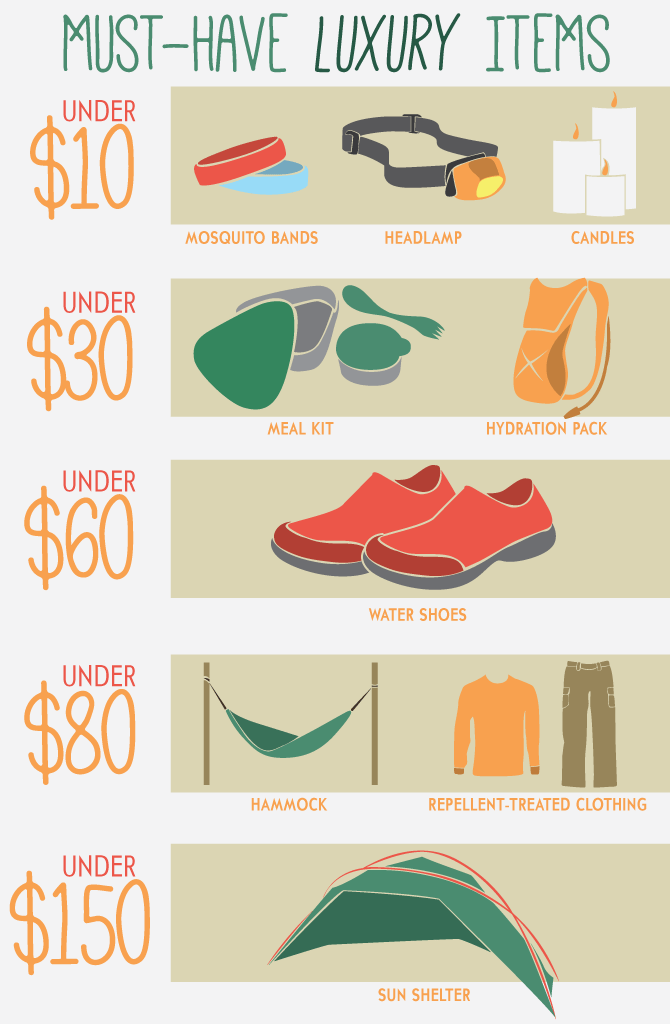
Must-Have Luxury Items - Follow these fun camping hacks to save time, space, and money on your next family trip!

Unfortunately, not every camping item can be “MacGyvered” from items you already own. A few camping “luxury” items can go a long way toward ultimate comfort and fun in the outdoors.


  • A good hammock: We stand behind the Grand Trunks Goods double hammock (as reviewed on PracticalTravelGear.com), which is easy to set up, comes in a compact stuff sack, and fits two people comfortably.
  • Headlamps for everyone: A headlamp can be picked up for under $10 and allows for hands-free illumination. We’ll never return to clumsy flashlights again.
  • Hydration packs: Want kids to stay hydrated? Outfit them with small hydration packs (one liter will do). Most day packs now fit hydration pack bladders, which can be purchased solo for under $30.
  • Water shoes for the family: Say goodbye to stubbed toes and splinters in little feet. Water shoes can be worn in and out of water, performing double duty as light hiking shoes. We love the Keens and Columbia options.
  • A dining set for every family member: Check out Light My Fire: this camping product company makes individual meal kits that include a plate, bowl, cup, and utensils that all fit together. Kids take pride in ownership, which means they’ll do their own dishes.
  • Mosquito bands, candles, or clothing: Mosquitos are an unfortunate evil of outdoor recreation, and repellent spray is often unhealthy and smelly. Mosquito bands are a non-intrusive alternative, and they can be bought for just a few dollars. Ditto for citronella candles, which can be set out on picnic tables after dark. If you want to go high-tech, try insecticide-treated clothing, with repellent infused directly into the fabric. Exofficio.com and Columbia.com both make shirts, pants, and bandanas in this fashion, but they won’t come cheap. “You can save some money by using Columbia coupon codes on your purchases.”
  • Sun and shade shelter: Everyone remembers a tent, but many campers overlook the convenience and comfort offered by a sun and shade shelter. These simple canopies can be set up over picnic tables for shaded meals and card games or brought to the lakeshore to protect kids from the sun.


Dining Hacks

Families can have all the right gear and convenient household items, but if you’re still slaving over the camp stove, your trip won’t be relaxing. The following dining hacks make meal prep and planning a breeze. We prefer to cook most of our meals over the campfire or on the BBQ to make food fun and clean-up simple.


  • Grill fruit on the barbecue: Fruit is more appealing than grilled veggies to kids, and with a little whipped cream, you can skip the marshmallows. We prefer to create fruit kabobs with stone fruit such as peaches, pineapple, grapes (cut in half for young children), and strawberries. Local berries bought at farm stands or even picked by the family work well, too.
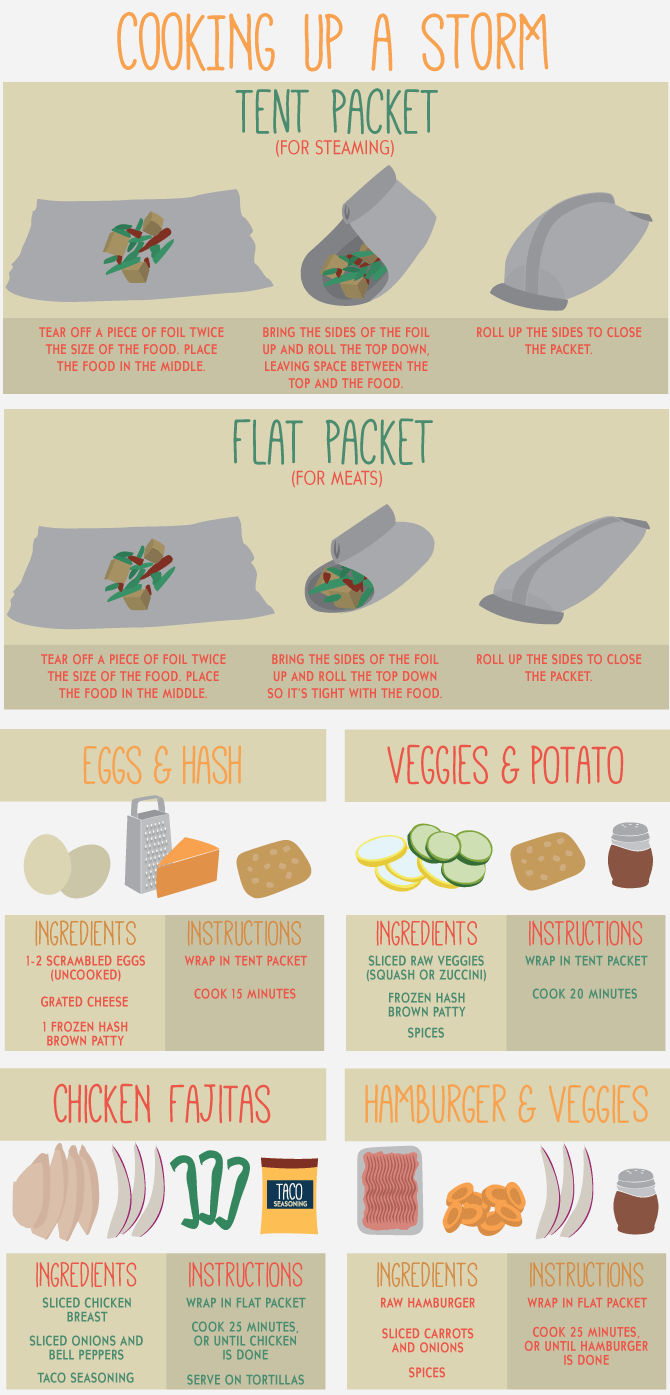
  • Make “pocket” dinners: Create pockets of tin foil and fill with sliced potatoes, zucchini, onions, and other veggies, and then let them cook in the coals. It’s best to use heavy duty foil to ensure that ashes don’t get into your meal. Each pocket is customizable and fun to eat! Best of all, when you’re done, simply ball up your foil and toss it on the fire. Dishes are done!
  • Pack milk substitutes instead of cow milk: Milk substitutes like soy, almond, and rice milk don’t have to be refrigerated, and vanilla or chocolate flavors are appealing to most kids, so there’s no need to worry about keeping milk cold for breakfast cereal.
  • Skip the dishes: Use empty snack-size chip bags as individual serving “bowls” for chili, stew, or even oatmeal. Kids love these “on-the-go” containers.
  • Don’t get fancier than boiled water: If you really want to simplify mealtime, buy dehydrated backpacking single- or double-serving meals. They taste just fine in the wilderness, require only boiling water, and take about five minutes to prepare.


Cooking Up A Storm - Taking children on a camping trip is rewarding but also hectic. Follow these camping hacks for families to make your next trek to the outdoors with children run smoothly

Camp Close to Home

There is no need to drive hours for a family camping trip. Find a campground close to home to keep stress at a minimum. Plus, being near home allows for spontaneous camping or quick returns home for forgotten items. Check your region’s state park listings and then search for available sites online. KOA.com is a good resource for campsites with kid-friendly amenities, like pools or mini golf courses. A short drive and familiarity with the surroundings helps campers to relax more quickly.

Source: Fix.com

The Benefits of Cattails as a Survival Food Source

This is a great article from Eat The Weeds, on the benefits of Cattails as a survival food source. It is a readily abundant wild edible in North America.

cattails as sorce of food

No green plant produces more edible starch per acre than the Cat O’ Nine Tails; not potatoes, rice, taros or yams. Plans were underway to feed American soldiers with that starch when WWII stopped. Lichen, not a green plant, might produce more carbs per acre. One acre of cattails can produce 6,475 pounds of flour per year on average (Harrington 1972).

It is said that if a lost person has found cattails, they have four of the five things they need to survive: Water, food, shelter and a source of fuel for heat—the dry old stalks. The one item missing is companionship.  Of course, the other thing to point out is that no matter where the water flows, down stream is civilization in North, Central and South America. 

Can cattails be a wild edible survival food source?

Cattails are the supermarket of the wilds. The young cob-like tips of the plant are edible as is the white bottom of the stalk, spurs off the main roots and spaghetti like rootlets off the main roots. They have vitamins A, B,and C, potassium and phosphorus. The pollen can be used like flour.  I like their convenience as a trail nibble, or canoe nibble as it were. Just pull on one and where it pulls from the stalk there’s usually a tasty bite or two.

Cattails are the champion of starch production. The way you get the starch is to clean the exterior of the roots and then crush them in clean water and let them sit. The starch settles to the bottom then one pours off the water.  It may take several drain and settle sessions get rid of the fiber. I sampled the starch raw once and got a bit of a stomach ache.  Once you have just the starch it is excellent for cooking as you would any flour. Getting starch that way is quite labor intensive. Here are three other ways to get to the root starch:

Dry the peeled roots (peel roots while they are wet–they are difficult to peel when dry). Chop roots into small pieces, and then pound them wtih a little water. When the long fibers are removed, the resultant goup powder can be dried and used as flour.   The roots also can be boiled like potatoes then the starch chewed out (spitting away the fibers) or you can also roast the root in a fire until the outer spongy core is completely black. Then chew the starch off of the fiber.  Don’t eat the fiber. It will give you a stomach ache. I know from personal experience. The advantage of the latter method is no pots or pans are needed. If you have fire and a pond you have a nutritious meal.  You can also put the roots on the barbecue.

[source]