
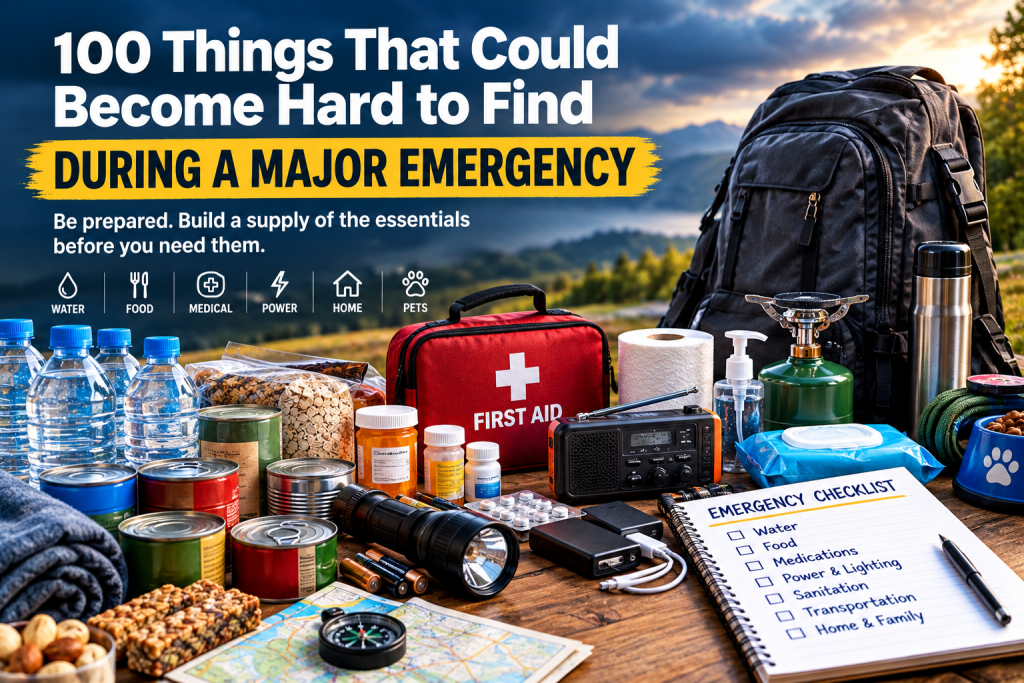
A practical emergency preparedness checklist for the supplies, products and everyday essentials that may become difficult to buy when normal life is disrupted.
Most people think emergency preparedness means buying a flashlight, a few cans of food and a first-aid kit.
Those things matter.
But there is another part of preparedness that is easy to overlook:
What happens when the things you normally buy aren’t available?
A major wildfire, earthquake, hurricane, winter storm, flood, extended power outage, water-system failure or other large-scale emergency can disrupt transportation, electricity, communications, fuel distribution, stores and supply chains.
At the same time, thousands or even millions of people may suddenly try to buy the same products.
That’s when ordinary household items can become difficult to find.
This isn’t an argument for panic buying.
It’s the opposite.
The goal is to build a reasonable household reserve before an emergency happens, so you aren’t completely dependent on a store having what you need when you need it.
The following 100 items are organized by category to help you identify the supplies that matter most to your household.
Preparedness principle: Don’t try to predict exactly what will disappear first. Prepare for the consequences of losing normal access to the things your household depends on.
Water & Water Treatment
Water should be near the top of every emergency preparedness list.
CDC guidance recommends storing at least 1 gallon of water per person per day for at least three days, while also encouraging households to consider storing more based on individual circumstances. Water needs can increase because of climate, medical conditions, pets and other household factors. CDC emergency water guidance
1. Bottled Water
Bottled water can disappear quickly when a community faces a water emergency, severe storm or evacuation.
Don’t assume you can make a last-minute trip to the supermarket.
2. Large Water Storage Containers
Food-grade water storage containers provide additional capacity beyond individual bottles.
Store and maintain them according to the manufacturer’s instructions.
3. Water Filters
A quality water filter can be useful when normal water access is interrupted.
Remember that filters are not universal. Different products remove different contaminants.
4. Water Purification Tablets
Water purification tablets provide a compact backup option for treating certain water sources.
Follow the manufacturer’s instructions carefully.
5. Unscented Household Bleach
Unscented household bleach can have specific emergency sanitation and water-treatment uses when used according to current public-health guidance.
However, bleach does not make every type of contaminated water safe. Water contaminated with fuel, toxic chemicals or radioactive materials cannot simply be made safe by boiling or disinfecting it. CDC: How to Make Water Safe in an Emergency
6. Reusable Water Bottles
Reusable bottles give each person a practical way to carry and ration water.
7. Water-Safe Storage Containers
Containers specifically designed for drinking-water storage can become difficult to find when everyone is preparing at once.
8. Water-Hauling Containers
Buckets, jugs, carts and other containers can become useful if water must be collected or transported.
Food & Food Preparation
A food shortage doesn’t necessarily mean there is no food.
The immediate problem during a major emergency may simply be access.
Deliveries can be delayed. Stores can close. Refrigeration can fail. Restaurants can shut down. Roads can become impassable.
And when large numbers of households suddenly start shopping, popular shelf-stable foods can disappear quickly.
9. Canned Foods
Canned vegetables, fruit, beans, meat, soups and other shelf-stable foods can form an important part of an emergency food supply.
Choose foods your household actually eats.
10. Rice
Rice is inexpensive, versatile and relatively easy to store properly.
11. Dried Beans
Dried beans provide a shelf-stable source of food and can be stored for extended periods under appropriate conditions.
12. Pasta
Pasta is compact, inexpensive and versatile.
13. Oats
Oats provide a simple breakfast option that can be stored without refrigeration.
14. Flour and Baking Supplies
Flour, yeast, baking powder and other basic ingredients are easy to overlook until normal grocery access is interrupted.
15. Cooking Oil
Cooking oil is a basic pantry item that can become inconvenient to replace when stores are unavailable.
16. Salt
Salt has everyday cooking uses and can also be useful for certain food-preservation methods.
17. Sugar and Sweeteners
Basic pantry ingredients can become surprisingly difficult to replace during a prolonged supply disruption.
18. Shelf-Stable Milk
Shelf-stable milk and appropriate alternatives can reduce dependence on refrigeration.
19. Infant Formula and Infant Food
Families with infants should maintain an emergency supply appropriate to their child’s needs.
CDC specifically recommends including specialty foods and infant supplies in emergency planning. CDC Personal Needs
20. Special-Diet Foods
Gluten-free, allergy-friendly, diabetic-friendly, low-sodium and other specialized foods can be much harder to replace than ordinary groceries.
21. Manual Can Opener
If you store canned food, keep a manual can opener.
It is one of the simplest pieces of emergency equipment you can own.
22. Emergency Cooking Equipment
An appropriate camping stove or other approved alternative cooking method can be useful when normal electric appliances aren’t available.
Always follow manufacturer instructions and use fuel-burning equipment only where the equipment is designed to operate.
23. Fuel for Approved Cooking Equipment
If your emergency cooking equipment requires fuel, the fuel itself becomes part of your preparedness plan.
Store it safely and according to applicable regulations and manufacturer instructions.
Refrigeration & Food Preservation
A power outage creates another problem:
The food you already have may become unsafe.
CDC guidance says a refrigerator generally keeps food safe for up to four hours without power if the door remains closed. A full freezer can maintain safe temperatures for approximately 48 hours, or about 24 hours if half full. CDC: Keep Food Safe After a Disaster or Emergency
24. Coolers
A quality cooler can become extremely valuable during an extended power outage.
25. Ice
Ice can become difficult to obtain when an entire community loses power.
26. Frozen Gel Packs
Reusable cold packs can provide another option for keeping food or other temperature-sensitive items cold when appropriate.
27. Food Thermometers
An appliance thermometer can help you determine whether food has remained at a safe temperature.
28. Shelf-Stable Foods
Foods that don’t depend on refrigeration reduce your dependence on the electrical grid.
Medical & Health Supplies
This category deserves special attention.
For some households, being unable to replace a medical supply isn’t merely inconvenient.
It can be dangerous.
CDC recommends considering prescription medicines, medical devices, eyeglasses, hearing aids, contact-lens supplies, inhalers, blood-sugar monitors and other personal medical needs when planning for emergencies. CDC Personal Needs
29. Prescription Medications
Maintain an appropriate emergency supply in accordance with your healthcare provider’s and pharmacist’s guidance.
30. Over-the-Counter Medications
Common household medications can become difficult to replace when stores are closed or supplies are disrupted.
31. First-Aid Supplies
Keep bandages, gauze, antiseptic supplies, gloves and other appropriate first-aid materials available.
32. Prescription Glasses
A damaged or lost pair of glasses can become a major problem if replacement services aren’t available.
33. Contact-Lens Supplies
Keep appropriate cleaning solution, cases and backup eyewear if needed.
34. Hearing-Aid Batteries
Small batteries are easy to overlook until you need them.
35. Blood-Glucose Testing Supplies
Anyone who monitors blood glucose should plan for the supplies necessary to continue doing so.
36. Medical Device Batteries and Backup Power
If an essential medical device depends on electricity or batteries, determine your backup plan before an outage occurs.
37. Protective Equipment
Gloves, masks, eye protection and other appropriate protective equipment may become scarce during certain emergencies.
38. Menstrual Hygiene Products
Period products are essential household supplies.
Maintain a reasonable reserve of the products your household normally uses.
39. Infant Diapers
Families with babies should maintain enough diapers and related supplies to handle an interruption in normal shopping.
40. Pet Medications
Pets can have medical needs too.
Include prescription medications and other critical veterinary supplies in your planning.
Hygiene & Sanitation
Food and water get most of the attention.
Sanitation often doesn’t.
That can change quickly when water, sewer, garbage collection or normal household services are disrupted.
41. Toilet Paper
Toilet paper became one of the most obvious examples of an everyday product that can disappear rapidly when consumers begin stockpiling.
42. Soap
Soap remains one of the most important basic hygiene supplies.
43. Hand Sanitizer
Keep an appropriate supply for situations where soap and safe running water aren’t readily available.
CDC recommends alcohol-based hand sanitizer containing at least 60% alcohol when soap and water aren’t available. CDC hand hygiene guidance
44. Wet Wipes
Wet wipes can help with personal hygiene when water is limited.
45. Heavy-Duty Trash Bags
Trash bags have applications far beyond garbage.
They can help with sanitation, cleanup, storage and temporary organization.
46. Disposable Gloves
Useful for cleanup, sanitation and handling potentially contaminated materials.
47. Feminine Hygiene Products
Maintain enough of the products your household normally uses.
48. Baby Wipes
Baby wipes can be useful for infant care and general hygiene when water access is limited.
49. Laundry Detergent
Laundry doesn’t stop because an emergency happens.
A supply of detergent can become useful during an extended disruption.
50. Cleaning and Disinfecting Supplies
Soap, disinfectants, paper towels, buckets and cleaning tools can become important during cleanup and recovery.
Lighting & Batteries
The importance of electricity becomes very obvious once it disappears.
51. Flashlights
Every household should have multiple reliable flashlights.
CDC includes flashlights and extra batteries among basic emergency-kit supplies. CDC Emergency Kit Guidance
52. Headlamps
A headlamp allows you to keep both hands available for repairs, cooking, medical care or moving safely.
53. Batteries
The batteries that power your equipment can become harder to find than the equipment itself.
54. Rechargeable Batteries
Rechargeable batteries can reduce dependence on disposable batteries when you have a reliable way to recharge them.
55. Battery Chargers
A charger is only useful if it works with the batteries and equipment you actually own.
56. Candles
Candles can provide light but introduce a fire hazard.
Never leave an open flame unattended.
57. Lanterns
Battery-powered lanterns can illuminate a room much more effectively than a small flashlight.
Backup Power & Electricity
Backup power is increasingly important for modern households.
But owning a generator or battery system isn’t enough.
You need to know what you intend to power, how long you need to power it and how you will operate it safely.
58. Portable Power Banks
A charged power bank can keep phones and other USB devices operating during an outage.
59. Solar Chargers
Solar chargers can provide another way to replenish certain devices when grid electricity isn’t available.
60. Portable Battery Power Stations
Battery power stations can provide quiet backup electricity for selected household equipment.
61. Generators
Generators can become difficult to obtain when a major storm or other event causes widespread outages.
62. Generator Fuel
A generator without an appropriate fuel supply may provide little practical benefit.
Store fuel only according to local requirements and manufacturer instructions.
63. Extension Cords
Appropriate extension cords may be necessary for portable backup equipment.
64. Professionally Installed Transfer Equipment
Some permanent backup-power systems require electrical installation by a qualified professional.
Never improvise a connection that could backfeed electricity into the utility grid.
65. Carbon Monoxide Detectors
Carbon monoxide is colorless and odorless and can cause serious injury or death.
Never use a generator, gasoline-powered engine or other fuel-burning equipment inside a home, garage or other enclosed space. CDC power outage safety
Communications & Information
During a major emergency, information can be almost as valuable as supplies.
66. Battery-Powered Radio
A battery-powered or appropriately powered emergency radio can provide access to official information when internet or cellular service isn’t available.
67. NOAA Weather Radio
For households exposed to severe weather, a weather radio can provide another source of emergency information.
68. Cell Phone Chargers
Keep the charging cables your household actually needs in an easy-to-find location.
69. Vehicle Chargers
A vehicle may provide another source of power for phones and small electronics.
70. Printed Emergency Contacts
Don’t assume your phone will always be available.
Keep important numbers on paper.
71. Paper Maps
GPS is extremely useful.
But a paper map doesn’t require a cellular network, internet connection or battery.
72. Backup Power for Communications Equipment
If internet or cellular service remains available during an outage, backup power may allow certain networking or communication equipment to continue operating.
Cash & Financial Access
An emergency doesn’t automatically mean banks stop functioning.
But power failures, network disruptions or damaged infrastructure can make electronic payments difficult.
73. Cash
Keep a reasonable emergency cash reserve in a secure location.
FEMA emergency-kit guidance has historically included cash and coins as part of household preparedness. FEMA emergency supplies guidance
74. Smaller Denominations
Smaller bills may be easier to use when businesses have difficulty processing electronic payments or making change.
75. Backup Payment Method
A second payment card or alternative payment method provides redundancy.
Transportation & Fuel
Transportation becomes especially important when roads, fuel stations, public transportation or delivery systems are disrupted.
76. Gasoline
Fuel demand can rise quickly before and after major emergencies.
Don’t wait until an evacuation is underway to discover your vehicle is nearly empty.
77. Diesel
Households and businesses that rely on diesel-powered vehicles or equipment should plan accordingly.
78. Propane
Propane can be important for certain grills, appliances and backup equipment.
79. Motor Oil
Basic vehicle maintenance supplies may become harder to replace during a supply disruption.
80. Tire Repair Supplies
A flat tire can become a much bigger problem when roadside assistance is overwhelmed.
81. Spare-Tire Equipment
Make sure your vehicle actually contains the equipment required to change a tire.
82. Jumper Cables or Battery Jump Starter
A dead battery can become a serious problem when roadside assistance is unavailable.
83. Windshield Washer Fluid
An inexpensive item that’s easy to overlook.
84. Vehicle Emergency Kit
Consider keeping water, nonperishable snacks, lighting, first aid, chargers, blankets, basic tools and other appropriate supplies in your vehicle.
Home Repair & Maintenance
After a storm, earthquake, wildfire, flood or other disaster, basic repair materials can disappear quickly.
85. Tarps
Tarps can provide temporary protection for damaged areas.
86. Duct Tape
Useful for temporary repairs, bundling, labeling and many other household applications.
87. Plastic Sheeting
Plastic sheeting can be useful for temporary protection, separation and cleanup.
88. Rope and Cordage
Cordage has numerous practical household and emergency uses.
89. Work Gloves
Protect your hands during cleanup and basic repair work.
90. Basic Hand Tools
A basic tool kit should include items such as:
- Pliers
- Screwdrivers
- Adjustable wrench
- Hammer
- Utility knife
- Tape measure
- Hex keys
- Socket set
91. Fasteners and Hardware
Screws, nails, bolts, washers and other basic hardware can become surprisingly difficult to replace after a major storm.
92. Fire Extinguishers
A properly maintained fire extinguisher is an important household safety item and is included in CDC emergency-kit guidance. CDC Emergency Kit Guidance
Personal, Family & Household Needs
The most important emergency supplies aren’t necessarily the things found on a generic checklist.
They’re the things your household specifically depends on.
93. Important Documents
Keep secure copies of identification, insurance information, medical information, financial records, emergency contacts and other critical documents.
94. Prescription Information
Maintain a current list of medications, dosages, prescribing providers and pharmacy information.
95. Pet Food
Pet food can disappear from shelves just as quickly as human food.
96. Pet Water
Include pets when calculating your household’s emergency water needs.
97. Pet Carriers and Leashes
If evacuation becomes necessary, you may need to transport animals quickly.
98. Infant Supplies
Formula, bottles, diapers, wipes, medications and other infant-specific supplies should be planned for separately.
99. Accessibility and Mobility Equipment
People who rely on wheelchairs, walkers, hearing aids, oxygen equipment, communication devices or other assistive technologies need emergency plans specific to those needs.
CDC specifically recommends planning for assistive technologies and home-use medical devices. CDC Personal Needs
100. The Supplies You Personally Cannot Replace
This is arguably the most important item on the entire list.
Your household has needs that no generic emergency checklist can predict.
Maybe it’s a specific medication.
A medical device.
Prescription glasses.
A child’s formula.
A pet’s medication.
A particular food.
A battery for an essential device.
A specialized charger.
Or equipment required for your job.
If your household depends on it and replacing it would be difficult during an emergency, it belongs on your preparedness list.
Don’t Panic-Buy. Build a Reserve.
A list like this can easily be misunderstood.
Preparedness isn’t about emptying store shelves before your neighbors do.
It’s about gradually building reasonable household reserves so you don’t have to depend on a last-minute shopping trip when everyone else is doing the same thing.
Start with the basics:
Water.
Food.
Medications.
Lighting.
Communication.
First aid.
Sanitation.
Power.
Transportation.
Personal needs.
Then build from there.
The objective isn’t to prepare for every imaginable disaster.
The objective is to make your household less dependent on immediate access to stores, electricity, transportation, communications and other services.
A Simple Way to Start
You don’t need all 100 items tomorrow.
Start by answering five questions.
1. What would my household need for 72 hours?
Write it down.
2. What would become a serious problem if we couldn’t shop for seven days?
Identify those items first.
3. What do we depend on every day?
Include medications, medical equipment, infant supplies, pet needs, dietary requirements and accessibility equipment.
4. What requires electricity?
Make a list of everything your household normally plugs in.
Then determine what happens if the power disappears.
5. What would we take if we had to leave?
Build a separate evacuation plan and portable emergency kit.
Build Your Emergency Supply Before You Need It
The biggest mistake in emergency preparedness is waiting until the emergency is already underway.
When a major event is approaching, everyone receives the same warning.
Everyone starts shopping.
Everyone wants water.
Everyone wants batteries.
Everyone wants fuel.
Everyone wants food.
Everyone wants medications.
Everyone wants generators.
You don’t need to predict exactly which product will disappear first.
You need to make sure your household isn’t completely dependent on the store having it when you need it.
Preparedness is ultimately about creating options.
A little preparation today can give your household significantly more flexibility when normal life is disrupted tomorrow.
Don’t prepare for panic. Prepare for interruption.
Emergency Preparedness Checklist
Use this list as a starting point, then customize it for your household.
Water
- Drinking water
- Water storage containers
- Water filter
- Water purification method
Food
- Shelf-stable food
- Canned foods
- Manual can opener
- Special-diet foods
- Infant food/formula
- Pet food
Medical
- Prescription medications
- First-aid kit
- OTC medications
- Prescription glasses
- Medical-device supplies
- Hearing-aid batteries
Power
- Flashlights
- Headlamps
- Batteries
- Power banks
- Backup power
- Generator, if appropriate
- Carbon monoxide detectors
Sanitation
- Toilet paper
- Soap
- Hand sanitizer
- Wet wipes
- Trash bags
- Cleaning supplies
Communication
- Emergency radio
- Phone chargers
- Printed contacts
- Paper maps
Transportation
- Fuel
- Vehicle emergency kit
- Spare-tire equipment
- Jumper cables/jump starter
- Tire repair supplies
Household
- Important documents
- Emergency cash
- Pet supplies
- Infant supplies
- Work gloves
- Basic tools
- Tarps
- Duct tape
- Fire extinguisher
Continue Preparing
Preparedness doesn’t end with one checklist.
Explore more Year Zero Survival resources:
Start Here:
Prepping for Beginners: How to Start Prepping in 90 Days
Water:
Saving Lives: Learn How to Obtain Drinkable Water in an Emergency Situation
Food:
Tips on Food Storage for an Emergency
Blackouts:
Essential Items for Your Black-Out Kit
Extended Power/Internet Outage:
Key Concepts for Surviving Without Power or Internet
Evacuation Planning:
Emergency Preparedness: Hazard-Specific Actions, Notification Systems, and Evacuation Planning
Vehicle Preparedness:
A Guide to Preparing Your Vehicle for an Emergency Evacuation
Final Thought
You don’t have to become a survivalist to be prepared.
You don’t need a bunker.
You don’t need a warehouse full of supplies.
And you don’t need to predict the next disaster.
You simply need to recognize that modern life depends on a remarkably complex system of stores, transportation, electricity, water, communications, fuel, healthcare and supply chains.
When those systems are disrupted, the things we normally take for granted can suddenly become difficult to obtain.
The best time to build a reasonable emergency reserve is before everyone else realizes they need one.