Know The Secret To Using Flint And Steel To Start A Fire?

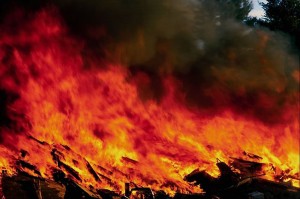
Iron Burning – Upon contact with the air, a shower of tiny iron particles spontaneously catch on fire.
Being prepared is the first step in survival.

Being prepared is the first step in survival.

Have you ever used a metal grinder or seen one in action on a piece of iron? Notice how thousands of glowing hot sparks fly off the wheel as it removes tiny bits of fresh iron off the chunk of iron being worked on. These tiny bits of iron are actually spontaneously catching on fire as they are exposed to the oxygen in the air.

If you can create a small enough particle of fresh iron, upon contact with oxygen in the air the iron particles increased surface area will oxidize faster than it can dissipate the heat formed during the reaction. The result: the particle of iron spontaneously becomes so hot that it glows as it oxidizes – and can be used to catch tinder on fire.

In a nutshell the process of using a flint and steel to start a fire works like this:

  • Find a piece of high carbon steel, which is about 98% iron and 2% carbon (a hard, relatively brittle steel)
  • Find a piece of flint or other hard sharp object such as quartz.
  • Strike a sharp edge of the flint a glancing blow with the high carbon steel. Doing this just right takes practice.
  • Very tiny particles of fresh iron fly out from the steel.
  • Upon contact with oxygen in the air, the surfaces of the iron particles spontaneously ignite and give off heat as they oxidize (rust).
  • Because the surface area of the iron particles is so large compared to their volume, the particles quickly heat up and glow red hot. They become sparks.
  • Catch the sparks in prepared tinder and use it to start a fire.

Advantages of Flint and Steel

Flint and steel has been used in starting fires for centuries. In the days before matches were invented, flint and steel offered the ability to start a fire without having to carry a hot coal wherever one traveled, and worrying about losing it or having it go cold.

Starting a fire using flint and steel takes a more expertise and preparation than simply striking a match, however many survival experts feel this disadvantage is overcome by the fact that a wet or damp flint and steel can still be used to start a fire, and that a flint and steel can start many thousands of fires without wearing out; both very important attributes when surviving in the wilderness.

Try carrying tens of thousands of matches in the wilderness or stockpiling thousands of matches in your disaster preparedness kit! Even if the shear weight and volume of your matches do not discourage you, you are also faced with the problem of keeping them viable from dampness or the ravages of time.

Flint and steel overcomes these problems and provides the survivor with means of starting a fire that is more reliable than matches – if he is skilled enough to use it.
source: How does flint and steel work? More specifically, what causes the sparks when you strike a piece of flint with steel? The answer may surprise you!

Potassium Iodide: What does it do?

In the aftermath of a nuclear emergency, radioactive Iodine can get into your body through eating, drinking or breathing.

Your thyroid gland may be seriously damaged as it absorbs this radioactive chemical. One way to protect this gland and prevent absorption is to make your thyroid “full” by taking non radioactive (KI)Potassium Iodide tablets.

The CDC recommends the following dosages upon advisories emergency officials. They may recommend taking one dose every 24 hours up to a few days.

This is especially important for pregnant woman, young adults and children.

Adults older than 40 should not take KI unless advised.

  • Adults should take 130 mg (one 130 mg tablet OR two 65 mg tablets OR two mL of solution).
  • Women who are breastfeeding should take the adult dose of 130 mg.
  • Children between 3 and 18 years of age should take 65 mg (one 65 mg tablet OR 1 mL of solution). Children who are adult size (greater than or equal to 150 pounds) should take the full adult dose, regardless of their age.
  • Infants and children between 1 month and 3 years of age should take 32 mg (½ of a 65 mg tablet OR ½ mL of solution). This dose is for both nursing and non-nursing infants and children.
  • Newborns from birth to 1 month of age should be given 16 mg (¼ of a 65 mg tablet or ¼ mL of solution). This dose is for both nursing and non-nursing newborn infants.

The CDC advises that KI “can protect only the thyroid from radioactive iodine, not other parts of the body”…and will not reverse damage that has already occurred.

We recommend the following educational site for more information: http://emergency.cdc.gov/radiation/ki.asp

Three R’s of Survival

These three R’s are just as important to survival as they are in everyday life.

#Recycle #Reuse #Repurpose

The 3 R's of Survival

In times of emergency and survival, you will have to be creative with your supplies and make do with whatever you can find and use to live and survive.

We will not be given the option to change our wasteful ways and find the most suitable ‘green’ way of living in a survival crisis. Every day items we take for granted will be unavailable and we need to ask ourselves what can be use to replace them. Thinking outside thebox will be a must.

So remember these 3 R’s of survival, Repurpose, Reuse, Recycle. Be prepared.


Be Ready when disaster strikes, prep for the unknown at Year Zero Survival

September Is National Preparedness Month

In honor of National Preparedness Month some handy information from FEMA

Resolve to be Ready in 2012

ARE YOU READY? GUIDE

AN IN-DEPTH GUIDE TO CITIZEN PREPAREDNESS

Are You Ready? An In-depth Guide to Citizen Preparedness (IS-22) is FEMA’s most comprehensive source on individual, family and community preparedness.  The guide has been revised, updated and enhanced in August 2004 to provide the public with the most current and up-to-date disaster preparedness information available.

  • What is Are You Ready?Open

  • Interactive course based on Are You Ready?Closed

Are You Ready? provides a step-by-step approach to disaster preparedness by walking the reader through how to get informed about local emergency plans, how to identify hazards that affect their local area and how to develop and maintain an emergency communications plan and disaster supplies kit. Other topics covered include evacuation, emergency public shelters, animals in disaster and information specific to people with access and functional needs.

Are You Ready? also provides in-depth information on specific hazards including what to do before, during and after each hazard type. The following hazards are covered: Floods, Tornadoes, Hurricanes, Thunderstorms and Lightning, Winter Storms and Extreme Cold, Extreme Heat, Earthquakes, Volcanoes, Landslide and Debris Flows (Mudslide), Tsunamis, Fires, Wildfires, Hazardous Materials Incidents, Household Chemical Emergencies, Nuclear Power Plant and Terrorism (including Explosion, Biological, Chemical, Nuclear and Radiological hazards).

Are You Ready? is also available in Spanish, and can be used in a variety of ways including as a read-through or reference guide. The guide can also be used as a study manual guide with credit awarded for successful completion and a 75 percent score on a final exam. Questions about the exam should be directed to the FEMA Independent Study Program by calling 1-800-238-3358 or by going to training.fema.gov/is.

Also available is the Are You Ready? Facilitator Guide (IS-22FG). The Facilitator Guide is a tool for those interested in delivering Are You Ready? content in a small group or classroom setting. The Facilitator Guide is an easy to use manual that has instruction modules for adults, older children and younger children. A resource CD is packaged with the Facilitator Guide that contains customizable presentation materials, sample training plans and other disaster preparedness education resources.

Copies of Are You Ready? and the Facilitator Guide are available through the FEMA publications warehouse (1.800.480.2520). For large quantities, your organization may reprint the publication. Please visit our reprint page for more information.

For more publications on disaster preparedness, visit the Community and Family Preparedness webpage.

Are You Ready? An In-depth Guide to Citizen Preparedness Full Document (PDF – 21Mb)


Be Prepared

Are you ready to survive?

Depend on Year Zero Survival and navigation equipment along with our survival tips and information to stay safe in any emergency or natural disaster.

Survival gear is extremly important when it comes to your family’s safety. Staying safe, hydrated, having survival food and other survival tools / gear is easy with Year Zero Survival. Our survival supplies are designed for portablility and practicality.

Basic survival gear is a must-have for any family, individual in your home, car or boat.

Being prepared is the first step in survival.


There are no products in this group.