Handy index of knots for any outdoors situation. Learn these and be ready.



Did you know that with proper storage techniques, you can have a lifetime supply of certain foods? Certain foods can stand the test of time, and continue being a lifeline to the families that stored it. Knowing which foods last indefinitely and how to store them are you keys to success.
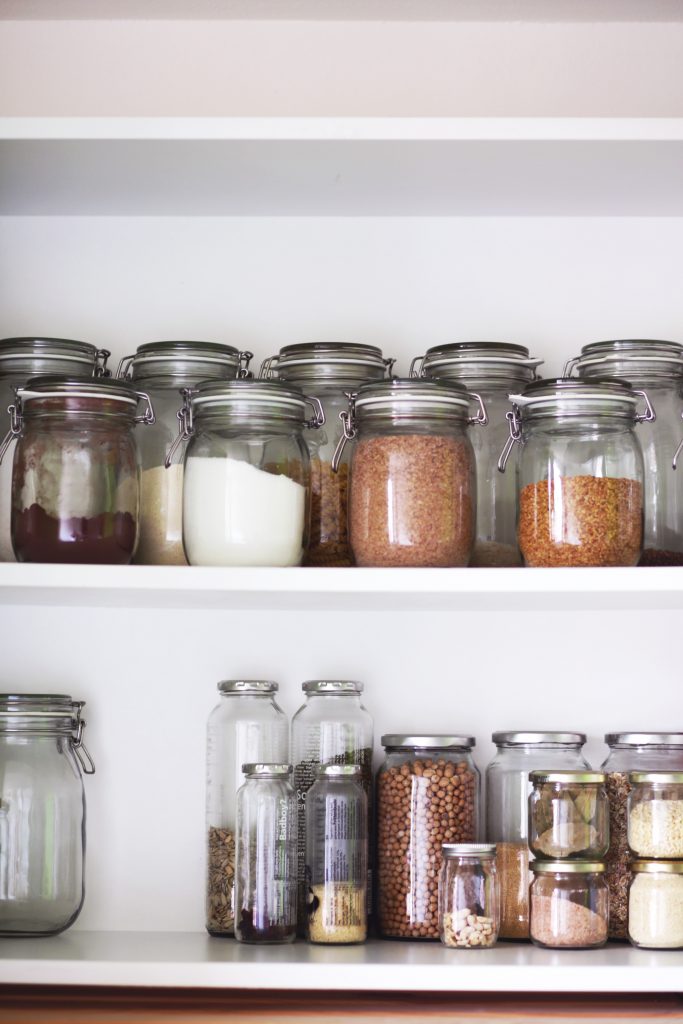
The best way to store food for the long term is by using a multi-barrier system. This system protects the food from natural elements such as moisture and sunlight, as well as from insect infestations.
Typically, those who store bulk foods look for inexpensive items that have multi-purposes and will last long term. Listed below are 11 food items that are not only multi-purpose preps, but they can last a lifetime!
Honey
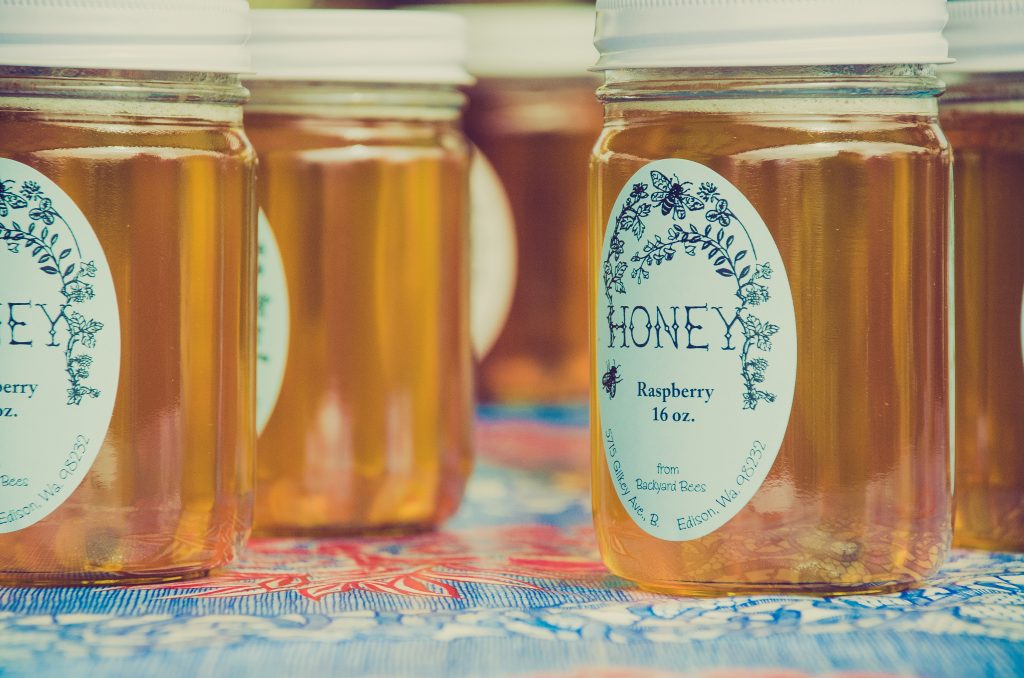
Honey never really goes bad. In a tomb in Egypt 3,000 years ago, honey was found and was still edible. If there are temperature fluctuations and sunlight, then the consistency and color can change. Many honey harvesters say that when honey crystallizes, then it can be re-heated and used just like fresh honey. Because of honey’s low water content, microorganisms do not like the environment.
Uses: curing, baking, medicinal, wine (mead)
Salt
Although salt is prone to absorbing moisture, it’s shelf life is indefinite. This indispensable mineral will be a valuable commodity in a long term disaster and will be a essential bartering item.
Uses: curing, preservative, cooking, cleaning, medicinal, tanning hides
Sugar
Life would be so boring without sugar. Much like salt, sugar is also prone to absorbing moisture, but this problem can be eradicated by adding some rice granules into the storage container.
Uses: sweetener for beverages, breads, cakes, preservative, curing, gardening, insecticide (equal parts of sugar and baking powder will kill cockroaches).
Wheat
Wheat is a major part of the diet for over 1/3 of the world. This popular staple supplies 20% of daily calories to a majority of the world population. Besides being a high carbohydrate food, wheat contains valuable protein, minerals, and vitamins. Wheat protein, when balanced by other foods that supply certain amino acids such as lysine, is an efficient source of protein.
Uses: baking, making alcohol, livestock feed, leavening agent
Dried corn
Essentially, dried corn can be substituted for any recipe that calls for fresh corn. Our ancestors began drying corn because of it’s short lived season. To extend the shelf life of corn, it has to be preserved by drying it out so it can be used later in the year.
Uses: soups, cornmeal, livestock feed, hominy and grits, heating source (do a search for corn burning fireplaces).
Baking soda
This multi-purpose prep is a must have for long term storage.
Uses: teeth cleaner, household cleaner, dish cleaner, laundry detergent booster, leavening agent for baked goods, tarnish remover
Instant coffee, tea, and cocoa
Adding these to your long term storage will not only add a variety to just drinking water, but will also lift morale. Instant coffee is high vacuum freeze dried. So, as long as it is not introduced to moisture, then it will last. Storage life for all teas and cocoas can be extended by using desiccant packets or oxygen absorbing packets, and by repackaging the items with a vacuum sealing.
Uses: beverages, flavor additions to baked goods
Non-carbonated soft drinks
Although many of us prefer carbonated beverages, over time the sugars break down and the drink flavor is altered. Non-carbonated beverages stand a longer test of time. And, as long as the bottles are stored in optimum conditions, they will last. Non-carbonated beverages include: vitamin water, Gatorade, juices, bottled water.
Uses: beverages, flavor additions to baked goods
White rice
White rice is a major staple item that preppers like to put away because it’s a great source for calories, cheap and has a long shelf life. If properly stored this popular food staple can last 30 years or more.
Uses: breakfast meal, addition to soups, side dishes, alternative to wheat flour
Bouillon products
Because bouillon products contain large amounts of salt, the product is preserved. However, over time, the taste of the bouillon could be altered. If storing bouillon cubes, it would be best repackage them using a food sealer or sealed in mylar bags.
Uses: flavoring dishes
Powdered milk – in nitrogen packed cans
Powdered milk can last indefinitely, however, it is advised to prolong it’s shelf life by either repackaging it for longer term storage, or placing it in the freezer. If the powdered milk developes an odor or has turned a yellowish tint, it’s time to discard.
Uses: beverage, dessert, ingredient for certain breads, addition to soup and baked goods.
source:
Author: Tess Pennington
Web Site: http://www.ReadyNutrition.com/
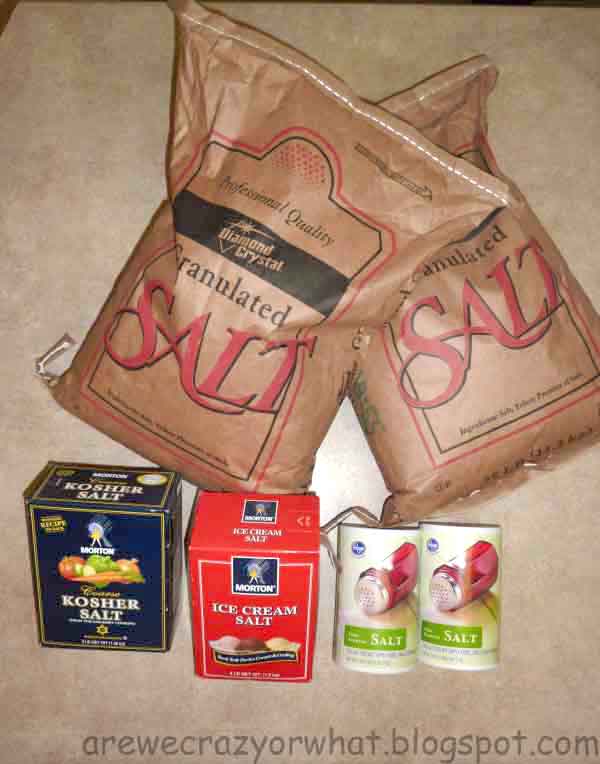
Table Salt: Table salt is the refined white crystal typically found in a salt shaker. It usually comes in a cardboard can and is the cheapest salt on the shelf at the grocery store. You can buy it with or without iodine added (more on that later). It generally contains an anti-clumping agent.
Sea Salt and/or Mineral Salt: (such as Himalayan Pink Crystal Salt or Celtic Sea Salt): All salt originally came from the sea so to call something sea salt is a bit misleading. Typically when something is labeled sea salt it is not refined and still has other minerals in it, whether it was mined or was processed out of sea water. The minerals salt contains vary according to where the salt was mined. Himalayan salt contains different minerals than Celtic sea salt. Sea salt that has been collected after water has evaporated or distilled also has other minerals from the ocean. There are a lot of “gourmet” salts on the market so it’s important
to read the label.
Koshering and Pickling Salt: Koshering salt (commonly known as kosher salt) generally consists of salt without additives I say generally because there are some brands that do contain additives, so always read the label. Kosher salt has a large flat grain helpful for the koshering process, and if it does not have any additives it can be used for canning. Pickling salt is refined salt with no anti-clumping agent and is used for canning – it has a very fine grain so it will dissolve quickly in liquids. Using table salt for canning discolors the food because of the additives.
Rock Salt and other salts: Rock salt (the kind found at the grocery store) is salt typically used in ice cream makers and is not approved for human consumption; again, it’s important to read the label. There are other types of salts available such as salt used in water softeners or salt used to help melt ice on roads. These are not meant for human consumption and should not be placed in food storage.
Salt is an important part of a healthy diet. Salt helps to balance electrolytes and is needed for proper cell function.Without salt we will die.
If you are eating from your food storage you may not be eating a lot of processed foods and the salt that you have stored could be your main salt intake. So it’s important to decide what kind of salt is best to store for your family. Iodine was added to salt to prevent Goitre. You can get iodine from other sources of food such as seafood, soil (if it is contained in the soil you grow your food in) or seaweed such as kelp or dulse. Also, most multi-vitamins contain iodine. The only down-side to storing salt with iodine is that it can turn yellow after time. If you’re storing salt as a trading item (see below), yellow salt might not look so appetizing. However, it’s still safe to eat and will store indefinitely. If you store table salt without iodine it will usually just contain an anti-clumping agent and will store indefinitely. Sea salt and mineral salt will also store well but not indefinitely. They would deteriorate according to the other minerals they contain. So reading the labels and doing an internet search on the minerals contained in the salt would give you an idea of the shelf life.
Table salt is cheapest of all the varieties of salt therefore it is easy to obtain a year’s supply for your family, which should be between 3-5 pounds a person, in a relatively short time. If you’re on a budget, like me, table salt might be your best option. You may also want to stock-up on pickling salt if you plan to preserve things from your garden. You would have to calculate how much according to the estimated yield from your garden for a given year. Pickling salt and table salt will store indefinitely, even if moisture seeps into the container, it can be laid out and dried.
Here’s what I did:
I bought two 25 pound bags of salt from a big box store. The bags do not contain iodine and this was my only choice from this store. I have a food saver but decided that I did not want to waste my storage bags because salt will not go rancid even if it’s exposed to air.
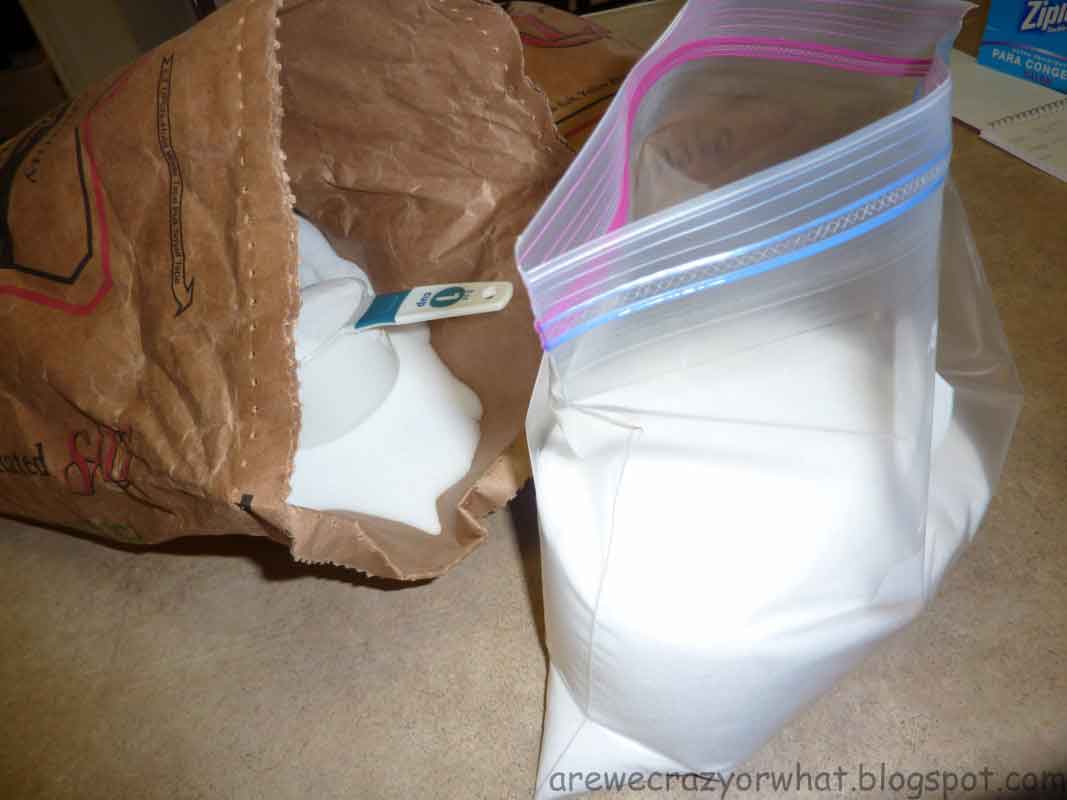
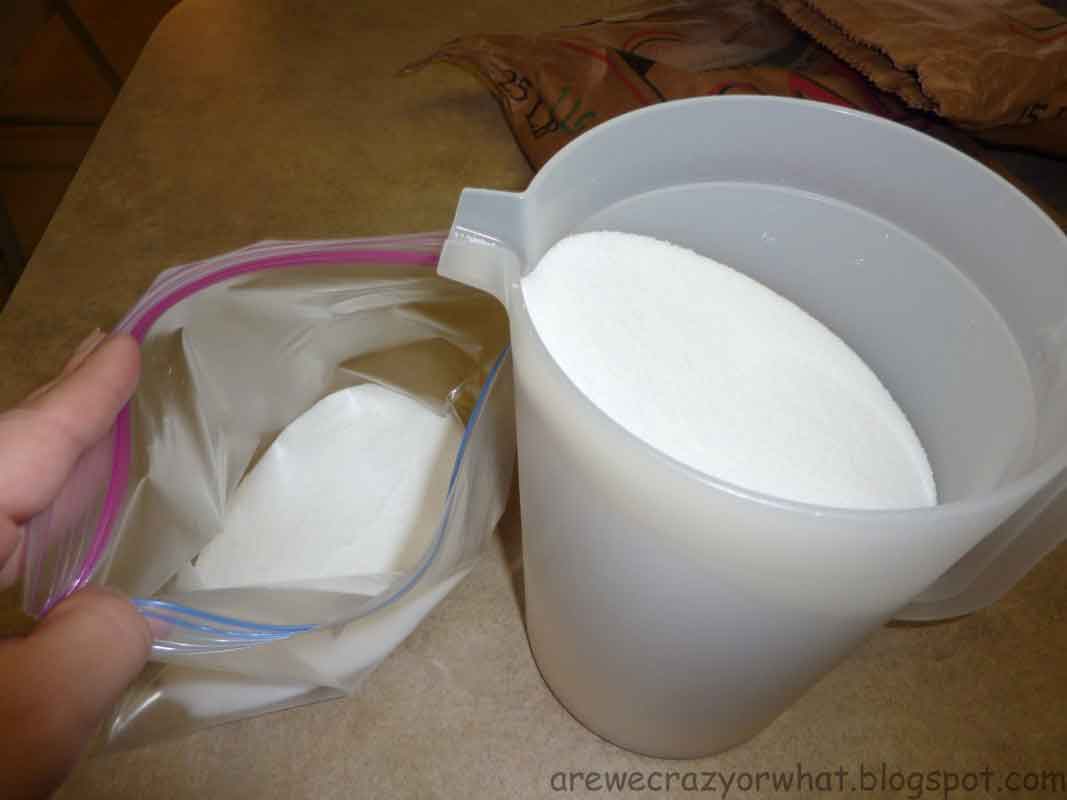
I scooped the salt into one gallon bags. I did not fill the bags all the way because I did not want the plastic to break. They will probably be retrieved by one of my children in our food rotation process so I wanted to make sure they were light enough to carry. I poured the salt into a pitcher because it’s very hard to pour a bag into a bag.
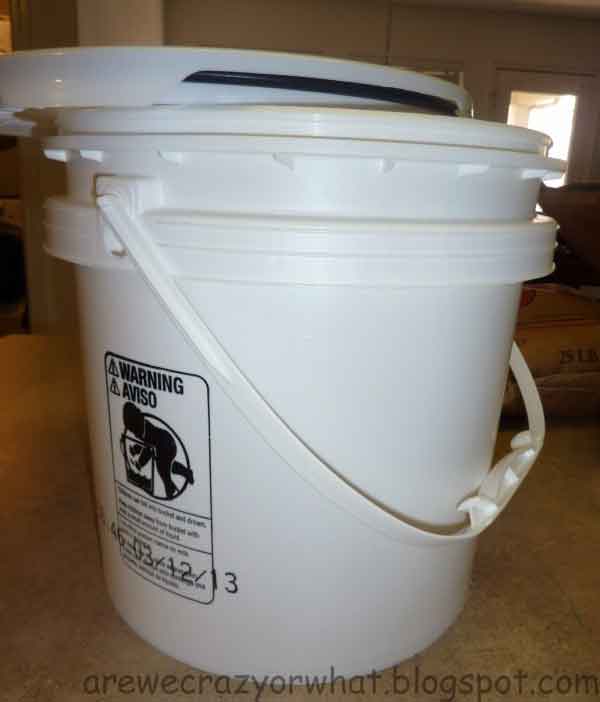

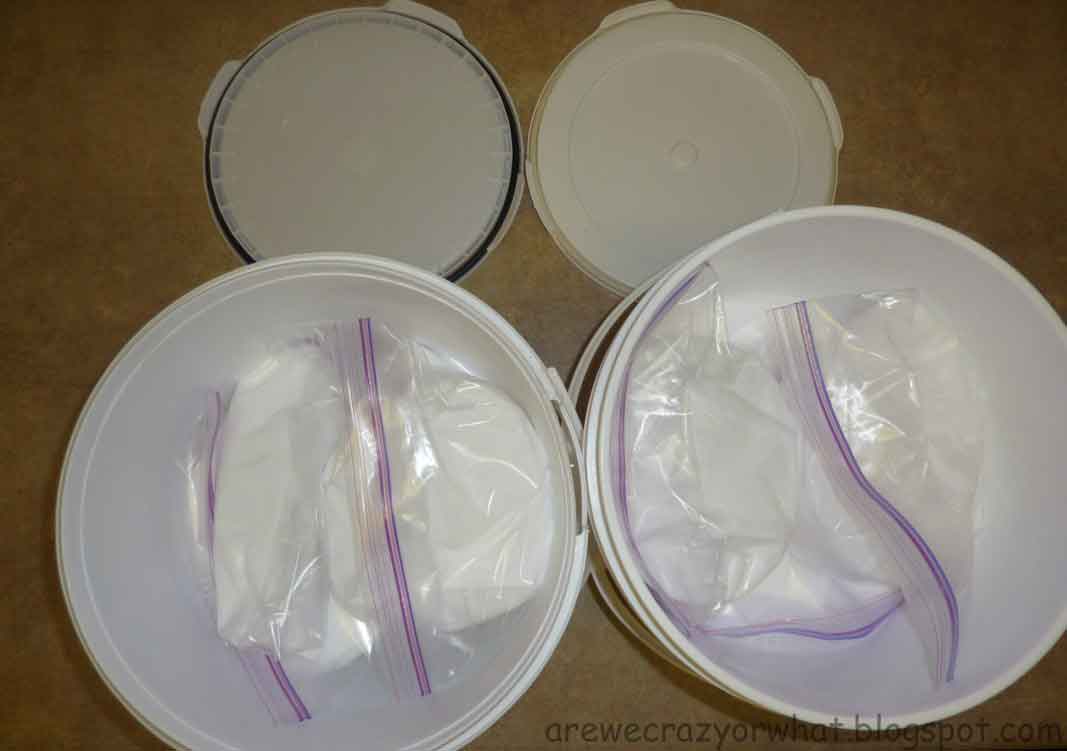 |


The sanitary pad’s origin lies in nineteenth-century battlefield hospitals to treat bullet wounds. Only after World War I did they take on their now-traditional use of female hygiene. In case of emergency, when medical attention may not be available, bleeding wounds treating will be a necessity. The pads could be quit handy to cover the wounds.
It is a lifesaver when used as a silent emergency beacon. It can be effective in both sun and moonlight, and can even start fires on a sunny day. Although a rescue team passing by still may miss your signal; an auditory signal from a whistle is certain to attract their attention.
Have a superficial wound that needs stitching? No medical staff, no needle and thread or no sewing training? No problem. While it will not do much for penetrating wounds like gunshots, super glue as an emergency suture can quickly bind and protect minor lacerations that otherwise could become infected.
You’ve seen it in the movies: guy gets shot, breaks apart a few bullets, pours the gunpowder over the wound and lights it. Guess what? While excruciatingly painful, it does exactly what is needed by sterilizing and cauterizing the wound.
Charcoal is amazing for some other uses than cooking: water purification. Drill a hole in the bottom of any type of plastic container, line it with the cheesecloth, place charcoal in it and pour in water – and voila, an instant water purification system! Afterwards, you can let the charcoal dry and cook your dinner with it.
The simple act of chewing a gum can suppress your appetite, thereby preserving limited food supplies for longer periods, while aiding in necessary saliva production.
Vinegar is a great antibacterial and microbial that can treat skin burns, inflammations and infections. As a cleaning agent it sanitizes and deodorizes, and can mask any odors which you’re afraid might give away your position to wildlife. A small amount mixed with water can also be swallowed to relieve an upset stomach, or to remove parasites from any contaminated water or undercooked venison you may accidentally consume.
Condoms are useful in another way than sex: water storage. Durable and stretchable, a condom can hold up to a gallon of water. They can also be used to protect against water, as a stretchable cover for valuable items like matches and walkie-talkies.
Musical tones – regardless of the source – have been shown to stimulate both the creative and pleasure centers of the brain; to help maintain focus and concentration; and to reduce anxiety and pain. The harmonica just might help maintain your sanity until the situation normalizes.
Most effective as a reliever of upset stomachs, there is an even better reason to have baking soda handy: fire. In an emergency, an inexpensive alternative for water, baking soda easily puts out cooking and other small fires that may occur while hunkered in your bunker.

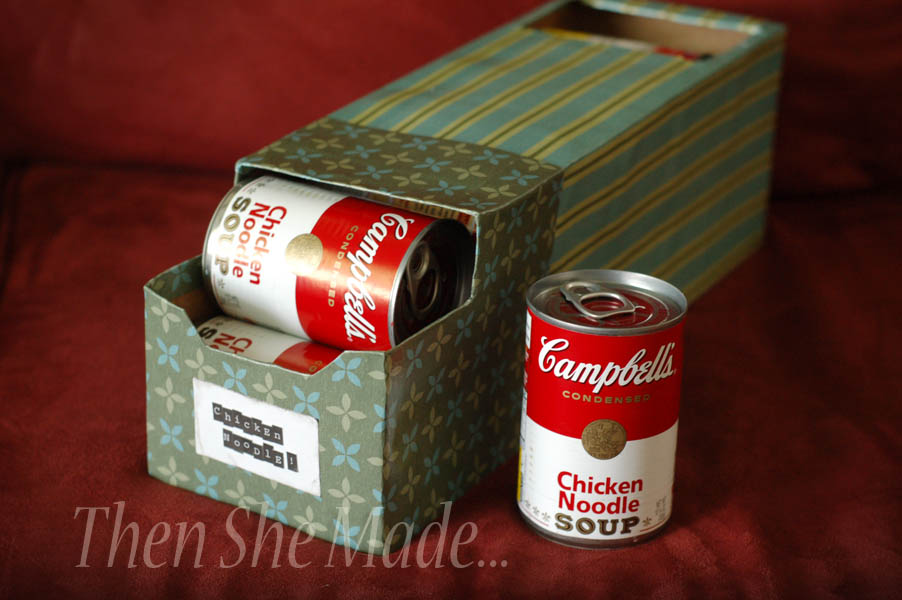
That’s what happened with my project for today. It actually came out of need. I don’t like stacking my cans. They never stay orderly. They always fall over. Or they get pushed to the back of the cupboard and I forget what I have and it BUGS me. So, I made this.


1- First, I needed an empty fridge pack of soda. My kids were thrilled to find rootbeer in the fridge. I bought it specifically for the packaging – is that wrong? Not really, just backwards, I guess.


Source: Then She Made...
So you’re minding your own business when all of a sudden, a nuclear bomb goes off, there’s a shock wave, fires all around, general destruction and you, having somehow survived, need a drink. What can you do? There is no running water, not where you are. But there is a convenience store. It’s been crushed by the shock wave, but there are still bottles of beer, Coke and diet soda intact on the floor.
So you wonder: Can I grab one of those beers and gulp it down? Or is it too radioactive? And what about taste? If I drink it, will it taste OK?
This could happen, no? Not to everybody, but let’s say it happens to you. Have you been wondering what to do?
Well, wonder no longer.
Thanks to my friend, science historian Alex Wellerstein, we are now in possession of a 1957 U.S. government study called “The Effect of Nuclear Explosions on Commercially Packaged Beverages,” which addresses this very question: After the bomb, can I drink the beer?
Written by three executives from Can Manufacturers Institute and the Glass Container Manufacturers Institute for the Federal Civil Defense Administration, the study says that after placing cans and bottles of soda and beer next to an actual atomic explosion, after measuring subsequent radioactivity and after actual taste tests, go ahead: Grab that can, pop it open and drink away.
“These beverages could be used as potable water sources for immediate emergency purposes as soon as the storage area is safe to enter after a nuclear explosion.”
If you can make it to the store, you can drink. How do they know this?
Well, in 1956, the Atomic Energy Commission exploded two bombs, one “with an energy release equivalent to 20 kilotons of TNT,” the other 30 kilotons, at a test site in Nevada. Bottles and cans were carefully placed various distances from ground zero. Notice, on this list, some of them are “returnable.”
The closest containers were placed “less than a quarter-mile away,” says Alex, “a mere 1,056 feet,” the outliers a couple of miles off. Some were buried, some left in batches, others were placed side by side. These images, copied from bad photocopies, are in the report. The cans, as you can see, survived.
Lots of bottles survived, too. Some were shattered by flying debris, fell off shelves, or got crushed by collapsing materials, but a surprising number stayed intact.
Will the beer be radioactive?
As for radiation, they checked, and found that bottles closest to ground zero were indeed radioactive, but only mildly so. Exposure, the authors say, “did not carry over to the contents.” The sodas and beer were “well within the permissible limits for emergency use,” which means, says Alex, “It won’t hurt you in the short term.”
Will it taste good?
But what about taste? Post-bomb beer might not poison you, but will it keep its flavor?
The report says, “Immediate taste tests [gotta wonder who got that job] indicated that the beverages, both beer and soft drinks, were still of commercial quality, although there was evidence of a slight flavor change in some of the products exposed at 1,270 feet from Ground Zero.” The most blasted beers were “definitely off.”
The first tasters then passed samples to selected laboratories for further testing, and this time the contents were rated “acceptable.” So here’s your government’s considered advice: Should you find yourself near an atomic blast and run short of potable water, you can chug a Coke or a beer, but don’t expect it to taste great.
What’s the lesson here?
There’s a second lesson here, Alex thinks. Because beverages in bottles and cans keep you safely hydrated in dire emergencies, it makes sense to keep a six-pack or two or three (or four), in the basement, just in case. What if there’s no lootable convenience store conveniently close by?
“For me, the takeaway here is that the next time you find yourself stocking up on beer, remember, it’s not just for the long weekend,” he says. “It might be for the end of days.”
If you want to see the government report, you can find it here. Alex Wellerstein’s analysis “Beer and the Apocalypse“ (which I used to write my story) appeared on his blog, Restricted Data.
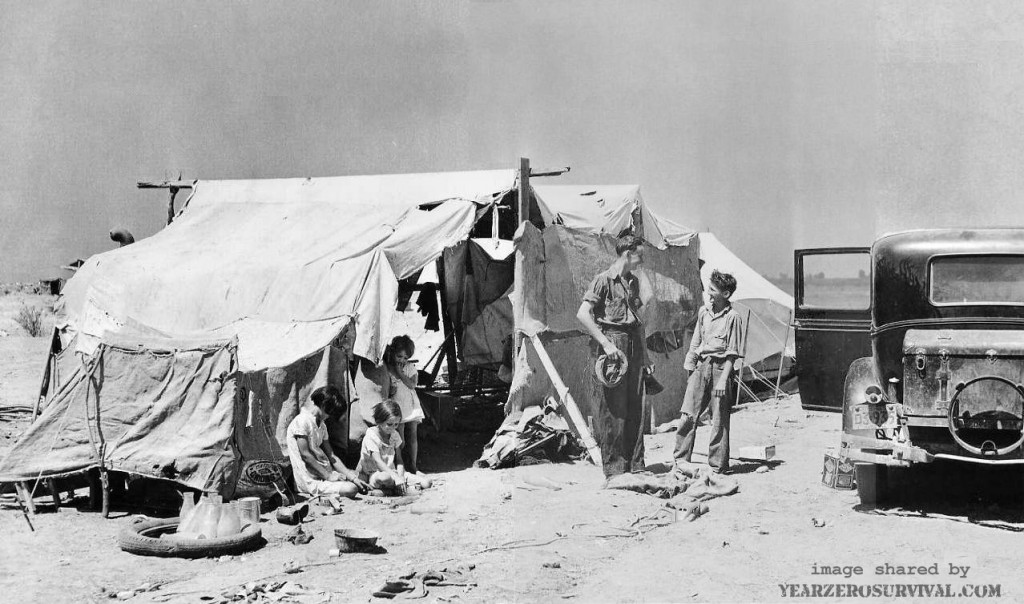
In its simplest form, a shelter is nothing more than a shell that traps a pocket of dead air warmed solely by body heat. In tree belts, such shelters are constructed of decomposing leaf litter and other organic debris; in barren, polar regions, they are made of snow. Knowing how to build even the simplest shelter could save your life in an emergency.
Wickiup
This forerunner of the tepee remains the quintessential primitive shelter -“sturdy enough to blunt prevailing winds, weatherproof, quickly built for nomadic hunters, but comfortable enough to serve as a long-term home. It can be partially enclosed or fully enclosed and vented to permit an inside fire.
Step One Tilt three poles together in tripod form and bind them together near the top. If you can find one or more poles with a Y at one end, tilt the others against the crotch, eliminating the need for cordage.
Step Two Tilt other poles against the wedges formed by the tripod in a circular form and thatch, leaving a front opening and a vent at the top for smoke.
Wigwam
A complex version of the wickiup, this is built with long, limber poles bent into a dome-shaped framework to maximize interior space.
Step One Inscribe a circle and dig holes at 2-foot intervals to accommodate the framing poles.
Step Two Drive the butt ends of the poles into the holes and bend the smaller ends over the top. Lash or weave the tops together, forming a dome-shaped framework.
Step Three Lace thin green poles horizontally around the framework for rigidity.
Step Four Thatch the framework, leaving entrance and vent holes.
Salish Subterranean Shelter
Used by Pacific tribes from Alaska to present-day California, pit shelters are impractical unless you have a digging implement, but they offer better protection from extreme heat and cold than above ground shelters.
Step One Dig a pit the circumference of the intended shelter to a depth of 3 feet.
Step Two Build a supporting tripod of poles, strengthening the framework with horizontally laced limbs.
Step Three Thatch the shelter, leaving a hole at the center to serve as both a laddered entrance and a smoke vent. Use earth removed from the pit to sod and insulate the shelter walls.
A-frame
The pitched roof of the A-frame bough shelter offers more protection against the wind than a lean-to and can still be heated by fire at the entrance. One drawback is that the occupant can’t lie down parallel to the fire for even warmth.
Step One Lift one end of a log and either lash it or wedge it into the crotch of a tree. Tilt poles on either side to form an A-frame roof.
Step Two Strengthen and thatch the roof as you would a bough lean-to.
Pole and Bough Lean-to
One of the most ancient shelters, the single wall of a lean-to serves triple duty as windbreak, fire reflector, and overhead shelter.
Step One Wedge a ridgepole into the crotches of closely growing trees (one end can rest on the ground if necessary), or support each end of the ridgepole with a tripod of upright poles lashed together near the top.
Step Two Tilt poles against the ridgepole to make a framework. To strengthen this, lace limber boughs through the poles at right angles.
Step Three Thatch the lean-to with slabs of bark or leafy or pine-needle branches, weaving them into the framework. Chink with sod, moss, or snow to further insulate.
Quintze Hut
Properly constructed, this poor man’s igloo can be body-heated to above freezing on a 20-below day, higher if you light a candle.
Step One Build up snow to a depth of at least 8 inches and pack it down to make a floor.
Step Two Heap loose snow onto the floor. Piling the snow over a backpack or mound of branches will let you create a hollow, which hastens the excavation process, but it isn’t necessary. Let the snow consolidate for an hour or more, until it is set up hard enough to form snowballs.
Step Three Tunnel through the mound at opposite ends to dig out the center efficiently, fill in the unused entrance, and crawl inside to shape the interior. Ideally, the quintze should be narrow at the foot end, with a bed long enough to lie down on, and just tall enough at the head end for you to sit up. The walls and roof need to be at least a foot thick (check this with a stick).
Step Four Poke out an air vent overhead and dig a well at the entrance for the cold air to settle into. Cut a snow block for a door. Glaze interior walls with a candle to prevent dripping.
Debris Hut
Heap up a big mound of duff and detritus from the forest floor, then excavate a pocket that is large enough to crawl into. After getting inside, partially block the doorway to minimize air circulation. If it isn’t cramped and dirty, you’ve made the air space too big for your body to heat it sufficiently.
Photo Gallery by Field & Stream Online Editors Source