Keep in mind, if something terrible happens, food stores are
not going to operate as usual, and you are going to figuring out how to find
your supplies.
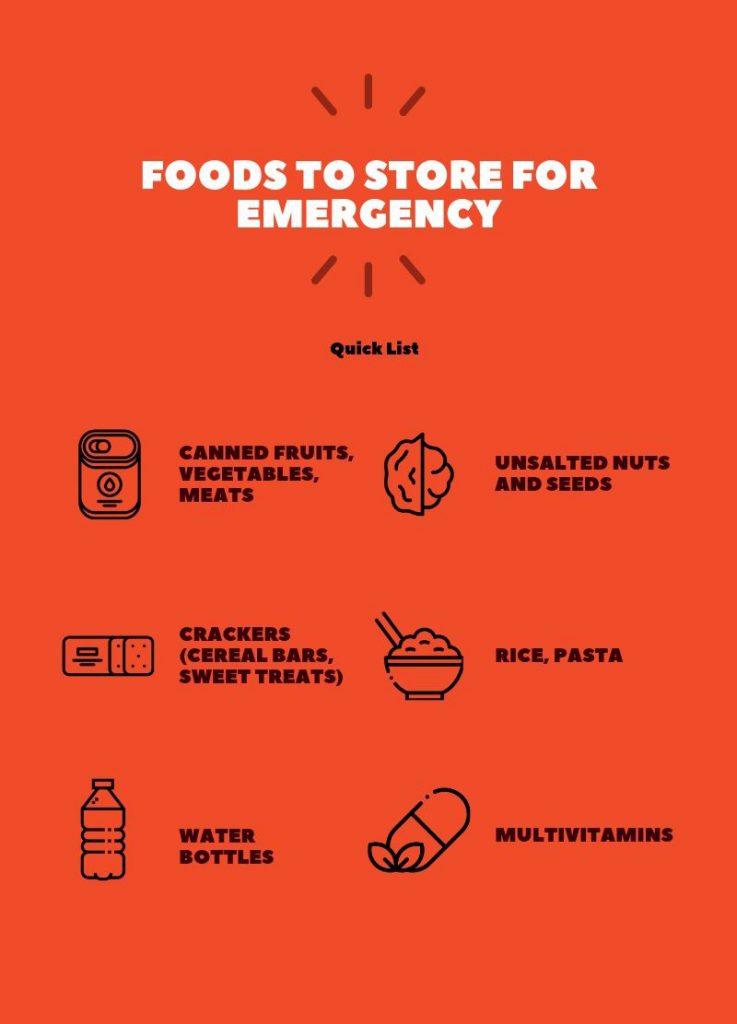
Food You Can Store
The most important
thing is to know what are the types of foods that can be stored.
Following are some
kinds of food items that can be stored for emergency.
Unsalted nuts and seeds (almonds,
walnuts, cashews)
Crackers (cereal bars, sweet treats)
Pasta
Rice
Peanut butter
Water bottles
Juice and shelf-stable milk or
nondairy alternatives
Multivitamins (calcium, fish oil,
vitamin C)
Honey
Important Things to Consider
There are several things to consider when storing food for
an emergency. Following are the significant things to concentrate,
– A well-organized pantry to store items for an emergency.
The pantry should be planned to store food for long term purpose without any
harm for food.
– Food security should be considered. When storing for an
emergency, it should be stored very safely because at the moment of emergency;
it should be safe if it is damaged can not use.
– Long term expiry dates. When purchasing the food items
should consider the expiry date, and it should be a long term one to store for
a long time.
– Make sure that storing fruits and meats are well dried up
to the storing condition — especially when preparing food at home for storing.
– Better to avoid frozen or refrigerated food for emergency
purpose. Because these kinds of food items can not keep outside for a long
time.
– Store the items for an emergency that are no need of
freezing or cooking as well as not taking much time for preparation.
Tips to Remember
There are various tips to store food for emergency purpose.
It is essential to know the tips to save correctly, as those things to be used
in an emergency.
If it is not stored correctly, no use at the time of crisis.
Following are few tips to remember:
– Food items should be well sealed and packed or canned to
avoid damages for the food.
– Properly label and categorize the food items to easy
access.
– Store with proper
quantities that are required for your family needs and wants.
– When storing food items do not forget to consider the
nutrition values.
– At the same time, give a significant consideration for the
tastes and flavors you and your family members prefer.
According to the things mentioned above, purchasing,
packaging, and storing properly holds significant importance at storing food
items for emergency purpose.
A bug out bag is basically pack of survival items that you can easily carry around with, especially with the aim of reaching your bug out location. The bug out backpack has to be resilient and comfortable enough for you to carry around, at least for 72 hours. The main reason of having a bug out bag is so that you can easily evacuate if there’s a need.
To have the ‘BEST’ bug out bag, you need to have an awesome
bag, and the bug out bag contents has to be planned as well. This would mean
you need a comprehensive bug out bag list. Having a quality bug out bag is only
half the battle, you need suitable survival gears and survival skills to face
the situation.
Do note, you can further split this into categories too such
as children’s Bug out bag or even a bug out bag for the elderly! There’s no
hard and fast rule as to how you should pack your bug out bag, but I’ll raise
some of the common items everyone should consider putting in their bug out bag.
In my view, there are some fundamental items your bag should
contain, and you can customize your bag for different emergency situations.
Important Rules
The purpose of making a bug out bag list is so that you will
have a clear idea of what you need (making a distinction between your wants and
needs). Although we don’t know what the future holds, you can’t be bringing too
many things. There’s no way you can carry it for long hours.
The goal is to keep only items that help you become
self-sufficient, surviving various situations. You don’t need to stuff any
fancy shmancy tools that you don’t use. With that said, let’s see what are the
top items you need for your bug out bag.
1. Water
Water is placed number 1 because of its importance. Without
getting proper water supply, your success of surviving a bug-out situation will
drastically decrease. I would suggest
prioritizing the need to get good water supply before even thinking about food.
Especially if you are caught in hot weather, you may suffer from dehydration.
Water can be seen in 2 aspects, (1) Storage and (2)
purification.
For Storage, you can use water bottles
or even sealed pouches. The water bottle you choose should be solid and has no
paint or coating.
Ideally, you should keep 3 liters of water in your bag
because it’s suggested that one adult should drink at least 1 liter of water
per day. Since you are aiming to survive for 72 hours, you’ll need 3 liters.
You can even get a Platypus Bladder, where most of them has
holsters for a bladder container which you can use to store water and drink
from it. Make sure to get one that is easily collapsible so that you can store
it with ease when you are not using it.
For Purification, you can keep some
iodine tablets or some other device to filter the water.
You need to pick your water purification tablets wisely
because there are a huge range of products in the market, manufactured for different
needs. For example, some tablets are made to purify water you obtain from
rivers.
Alternatively, you can pack water filters such as LifeStraw.
They are often compact, which makes packing them easy.
To kill two birds with one stone, I would suggest storing a
backpack stove because they are an excellent tool for cooking water and food.
Let’s be real, it’s extremely time consuming to get an A-frame logwood to
ignite. This would be highly dependent on your surroundings as well, if the
temperature is cold or its drizzling, the probability of you successfully
setting up a campfire would fall drastically.
Since water is heavy, you need to consider how to balance
the need to pack clean water, and getting water purifiers as substitute.
2. Food
Next, you may want to ensure that you have enough food
supply. There are several criteria to consider, including how long the food can
last, how much energy content does it contain and what nutrients it has.
You definitely need to keep some food supply packed in your
bug out bag to keep your body healthy and obtain stamina. You should definitely
consider the weight of the food as well.
If you live in a rural setting, you can consider packing
hunting gears so that you can hunt animals as a source of food when you are en
route to your bug out location.
If you don’t want to make things complicated, you can just
get any energy bars that is jam-packed with calories. If you want to be more
careful with what food you pack, you can check out this list of food which I
recommend having:
Energy bars – It’s
important that you distinguish between a food bar, a ration bar and even a
candy bar. Candy bar is self-explanatory, so I’ll skip that.
Ration bars are
often packed in mylar, which are made of a combination of flour, vitamins and
electrolytes. Ration bars usually have a bland taste, made to address a
particular emergency situation.
Since there are many types and flavors in the market, you
need to test them out to see which one you like. You can check out Mayday Apple
Cinnamon Bar which come in individual packets and they come with specific
flavours. Or, you can even choose the Datrex 3600 Food Ration Bar which comes
with multiple bars with each sub-packaged to ensure freshness.
Some do not consider this as food for your bug out bag
because they are designed to save lives (such as being stored in
lifeboats). But to me, they are
fundamental items you should store as well.
For Food bars,
they are portable bars which taste better than ration bars. Most of them taste
like candy or even cookies. These bars are made to give you energy and
sufficient nutrition as well. However, ration bars tend to give more nutrients
because they are ‘made’ that way.
You can check out Clif Bars to get food bars that have a
good source of protein and fiber.
MREs – Meals
Ready to Eat (MREs) or “wet food” often taste better than energy bars. Also,
most MREs are made to last for years. If you would like to prioritize long-term
storage, MREs would be your top pick.
However, your body may have some reactions to MREs if you
are not used to consuming them. This can be solved by getting your body used to
it.
Dehydrated Food –
Dehydrated foods are excellent for long-term storage but they are a bit pricey.
Dehydrated food requires a reasonable amount of water to re-constitute, which
cause you to use-up some clean water-supply.
Mountain House is THE company to look out for when it comes
to dehydrated food. They are known for producing survival food kits and
dehydrated food that taste awesome!
3. Clothing
Clothing comes hand in hand with shelter, because both of
them are aimed to protect you from external elements.
Although there are various disaster scenarios that you may
be caught in, you can still reasonably predict what environment you will be in
when Shit Hit the Fan.
To make your thought-system more systematic, you can think
of what layer of clothing you need to pack for.
For myself, I would like to see it as Base Layer Clothing,
Mid-layer clothing and outer-layer clothing. Each layer has different functions
and purposes.
The base layer is meant to keep your body as dry as
possible. This means that getting a fabric that easily absorbs moisture would
be ideal. Keeping your body dry throughout the bug out scenario is important to
avoid bacterial growth and it helps keep you comfortable. I’ll suggest that you
use cotton or wool for base layer clothing.
For mid-layer clothing, its purpose is to help maintain your
body temperature. Therefore, it’s important that you get a mid-layer clothing
with good insulative qualities. For this layer, the materials which you can
look out for is cotton, wool and fleece.
The Outer layer should be waterproof and durable but allows
moisture to escape. One excellent material you can consider is jackets that are
coated with membrane.
With that said, here are some general ideas for what clothes
you need to pack – spare clothes, long pants, coat, boots, extra socks,
mid-layer shirts and a hat.
4.Shelter
In your bug out bag, you need to include some type of shelter
to protect your body from external elements. You can either pack a tarpaulin
sheet, a tent or a sleeping bag.
Tents are really
comfortable to be in, but they are heavy and bulky. Try to get a tent that
weighs less than 5 lbs so that you won’t go overboard on the weight.
If you are looking for something more portable, you can opt
for tarps. Since you can set them up into different configurations, they are
definitely more feasible to be used in most situations.
Since ‘shelter’ include anything that protects your body
from external elements, it will include fire starting kits as well.
A general list of items you can consider include a space
blankets (first aid blankets), poncho, Tarp, sleeping bags and tents.
As for a list of items to help you maintain surrounding heat.,
you can consider getting a firestarting kit, single Burner Folding stove, hand
warmer and windproof torch lighter.
Shelter is important because exposure to cold temperature
for long hours can kill you. If you stay in a place with extreme weather, you
need to take shelter SERIOUSLY. For cold weather, you will need to find ways to
create heat sources so that you can retain your body heat. Make sure you don’t
lose your body heat unnecessarily.
If you live in an area with warm weather, you may have to
consider bringing more water and packing more loose clothing.
5. Medical Supplies
Getting ready a first aid kit in your bug out bag is a
MUST-HAVE. Usually, they won’t take up a lot of space.
Medical supplies are highly personalized, so you need to mull
through what you need to use. This includes going through what are the
potential diseases that you will likely contract.
To do this, you need to know what are the injuries that you
will most likely face in a bugging out situation. There are various categories
of injuries including Traumatic injuries, burn injuries, minor wounds, mobility
injuries, infectious diseases and your individual medical needs.
To understand your individual medical needs, you need to go
through a personal screening by talking to your doctor and ask what are the
medicines you need.
Generally, it’s important to include some basic items such a
bandage, disinfectants and scissors. Other items you can consider are
Tourniquets, Israeli Bandages, Hygiene Kit, Wet Naps or even ThyroSafe
Potassium Iodine Tablets.
To Sum Up
I hope that the bug out bag list has helped you consider
different aspects as to what you should pack. This list is aimed to help you
create a new bug out bag list, which is definitely not an exhaustive list. Feel
free to give your suggestions in the comments on what to add in the list.
Bear in mind the important factors when considering which items you want to store in your bag. Be sure to take into account other considerations too such as what location you live in, what bug-out skills you have, what are the likely threat you will face and how many people you need to protect. With all these factors considered, I am sure your success of surviving a calamity will drastically increase.
I have been an active prepper since 2016. Although it’s only been a few years, I have learnt a lot along the way. I have spent hours reading before purchasing a gear. Also, I have spent hours practicing survival skills such as building a lean-to shelter or getting an A-Frame fire kindling. Hope you love the blog as much as I enjoy writing it.
How will you stay clean post-collapse? It’s an issue people don’t give much thought about, yet of crucial importance. Disease is one enemy that can take you down without realizing it, and no amount of tools, gear or survival skills can help.
The people who found refuge on the Louisiana Superdome during Katrina know very well what it’s like. Rotten food, lack of showers and functional toilets, no electricity was hard to endure for the thousands who were crammed into that open space. We need to be prepared, so let’s see some common sense hygiene tips…
#1. Water, water and more water.
Having the means to procure water is the cornerstone of any good hygiene plan. Not just for keeping you hydrated, but also for things like:
showering (or, at the very least, to use a damp cloth to wash your body if you don’t have enough of)
doing the dishes (though you could stockpile plastic plates and plastic eating utensils to save water)
washing clothes
cleaning wounds (yes, you could get hurt!)
and other things unrelated to hygiene such as watering your garden
Let’s face it, the moment we run out of water, our lives become 10 times more complicated. I’ll even go as far as to say that not having it is way worse than having no electricity.
Ways to ensure you’ve got plenty of water post-collapse:
get large, 55-gallon barrels and, if you have a back yard, large water tanks
install a rainwater harvesting system
have means to filter and purify water in your bug out bag as well as the trunk of your bug out vehicle
split your water stockpile between your home and your bug out location, because you never know where you’ll end up
keep extra room in the trunk of your bug out vehicle so you can carry extra water with you to your BOL (if there’s time to load it)
re-use water from the kitchen sink and shower to water your garden
#2. “If it’s yellow, let it mellow”.
You don’t have to flush the toilet every time. This may not be something you want to do right now but definitely something to keep in mind post-collapse. Follow the “if it’s yellow, let it mellow” rule.
#3. Keep contact with other people to a minimum.
This doesn’t mean you have to stop seeing other people, because you might need information or help. Just remember to avoid touching them, including shaking hands. It may not be polite but manners won’t be as important after the big one hits.
#4. Out of soap or shampoo? Use soapwort!
No, this isn’t some brand of organic soap I’m advertising. Soapwort (lat. saponaria oficinalis) is a perennial plant with beautiful pinkish-violet flowers that can make a great substitute for soap and shampoo. One thing to keep in mind is that it’s “mildly poisonous” if you eat it so only use it externally. There’re plenty of recipes on other sites and the list of ingredients is very short.
#5. Keep dirty clothes contained.
This is especially true if you’re camping somewhere in the woods or if you’re bugging out. All dirty clothes should be stored in plastic bags until you have a chance to wash and dry them.
#6. Show some skin.
The best way to avoid dirty clothes is to avoid wearing them! Now, I’m not sure if the temperature will allow it but if you can, go ahead and do it. One way of getting yourself used to wearing less clothing is to do what I started doing 6 months ago: I stopped wearing pajamas. If you’re older, you should check with your doctor before doing it, but I can tell you it’s working for me.
The benefits? Better immune system, less sweating, your body gets accustomed with lower temperatures (which you might have to face if you’re going to sleep outside) and, best of all, less laundry!
#7. Comb
Combing requires no shampoo and no water, you just have to you remember to add one to your bug out bag. Benefits of combing include removing dandruff, uric acid crystal deposits and other waste. There’s also a side benefit in that you stimulate the blood vessels to bring more blood to your hair, making it stronger and shinier.
#8. No toilet paper? No problem.
There’re plenty of other options that our ancestors used before TP was invented. Things like cloths, newspapers, the leaves of some plants and more.
#9. Remove facial hair.
Though this is an ongoing debate among preppers, you will be less likely to host parasites if you shave your beard and mustache and keep your hair short.
#10. Get a travel sports towel.
If you thought the only way to pack a towel is to sacrifice a good amount of space, I have the solution. There are so-called camp towels that are not only compact but also very absorbent. You can find them on Amazon for around 15 bucks a piece.
#11. Keep your fingernails and toenails neat.
This is very important, as all sorts of bacteria will gather underneath. All you need is nail clippers that you can throw in your bug out bag as part of your hygiene kit.
#12. Take care of your teeth.
Brushing, flossing and using mouthwash should be done DAILY, regardless of whether or not you’re in a disaster situation. Cavities are one of the last things you want to deal with when there’s chaos all around you.
#12. Keep your hands clean.
If you’re doing a lot of office work, you probably don’t feel the need to wash that often. But when you’re working the field and the garden all they, when you’re feeding the animals, fixing your home and doing your own cooking, you’re going to have to wash A LOT more often. You’re also going to need soap (or the means to produce it) and/or hand sanitizer. It’s always a good idea to keep some sanitizer in your BOB and BOV.
Final Word
The thing I hope for the most is that you act on the advice I’ve given you. The tips are easy to put into practice and, some of them should be done on a daily basis, anyway. Post-collapse, you need to be a little more rigorous, so why not start today?
Successful camping and hunting should be characterized by fun, the desired outcome, and safe adventure. It is possible to realize the best hunting experience with proper planning and preparations. The jungle may be hostile, and terrains are changing; thus, you need the new tips to have a successful hunting and camping. Here is how you can make the experience more exciting without risks.
Safety first- pitch your camp away from danger and dress in protective gear
When you go out hunting and camping, you should be able to get back in sound health if not re-energized. You having your camp miles away from the field will ensure you avoid attacks during the night. Some diseases can be transmitted from the animals to humans, and thus, it is advisable that you take necessary precautions. Having your tent away from the field will also ensure that you don’t scare away the prey; hence, you will increase your chances of making a kill. Carry a first aid kit as well.
2. Have the necessary equipment with you
Some of the material that you will readily think of packing when going for hunting and camping include the weapons, safety belts, and binoculars. You will have your focus on the big occasion, and it is appropriate that you prepare early enough. It would help if you started packing since some of the basic stuff are likely to be left out when you don’t have a checklist. You can’t avoid going without a compass. Without the native compass, you will get frustrated when you lose directions in the process. However, it is vital that you keep your load manageable as well.
3. Carry sufficient food
You must keep stable during the hunting period. It would be best if you carried adequate meal and snack with you to the hunting fields. The diet should sustain you for the entire duration. Running out of food and other necessities will disrupt your adventure since you have to cut it short or replenish your stock. Often people tend to think that they will catch the deer and feast from day one. This may not be true at times; hence, you will starve when you fail to carry adequate food.
4. Learn the state’s hunting regulation
Acquainting yourself with the laws of the land will help you avoid contravening, which will limit or make the event get chaotic. Requirements differ from one region to another, and it is prudent that you learn of the new laws in the original jurisdiction. You should ensure that you get the necessary documentation and carry them along in the trip. Engaging in illegal hunting can curtail your camping and hunting experience.
5. You can bring entertainment with you
You will be away from home, but the camping site should be your new home. Bring along everything that will make you comfortable. It is good that you carry the Bluetooth speaker with your playlist loaded the latest music. Entertainment should not miss in the experience. Have an excellent speaker and good music to keep you company if you are to be alone. All your devices should be well powered during this period.
As a student, you need to view homework as more than just a way to improve your grades in school. Learning should not be centered around the four walls of a classroom. When you have the right attitude toward learning, and toward your biology homework, you will learn skills that are essential for survival in different situations. You see, biology as a science studies life forms. It dwells on everything regarding life from the single cell organisms to multi-cell organisms. Freelance writers who write about biology can testify to this fact that knowledge of biology is key to survival.
5 Reasons Why Interest In Biology Can Save
Your Life
1. In Case You Get Frostbite
Frostbite can happen when you stay in cold
regions for an extended period. Whether you’re there by choice or by force,
knowledge of biology can help you survive. While a mild case of frostbite will
not cause any lasting damage, a more serious case can lead to a number of
severe symptoms. Some of these include blistering, loss of feeling, cold
sensitive, and hypothermia all of which can lead to death. The worst mistake
you can make at a time like this is using friction to warm the part of your
body that is affected. This can damage your tissue.
2. In Case Of A Heart Attack
While heart attacks are more likely to happen
to people who are more advanced in age, youths still have a slight risk of
having a heart attack. When the body can no longer pump blood to the heart
efficiently, the heart muscles suffer a deficit in oxygen and die. From a
biology textbook or articles written by freelance writers, you can learn the
symptoms of a heart attack and seek out professional help. Taking an aspirin tablet as soon as you notice the symptoms
can reduce the risk of clot formation. If you’re not the one having the heart
attack and the patient is not responding, attempt cardiopulmonary resuscitation
with your hands.
3. In Case You Suffer Burns
There are several circumstances that can lead to burns. Whatever the case may be, knowing about the human body will help you get or provide instant relief before experts get there. Most people think the best way to relieve a burn is with ice. This is only going to damage the burnt skin more. The best thing to do in such a situation is to use a sterile dressing to cover the affected skin and wait for the medical team to arrive.
4. In Case Of Convulsions
If someone around you suffers a convulsion,
you can quickly check the internet for an article about how to provide first
aid. There are many articles by freelance writers about this emergency. A
convulsion is also called a seizure and it’s a situation where a person suffers
rhythmic movements of the muscles that cannot be controlled. It happens when
the brain receives abnormal electrical impulses. While these seizures can stop
without any first aid, you can help the victim by assisting them to lay down in
a comfortable position. It’s common to see people put objects in their mouths
but this should be avoided. Just remove harmful objects from the environment
and wait for a medical professional.
5. In Case Of A Traumatic Head Injury
You can suffer a traumatic head injury when you hit your head hard. If you don’t get medical attention as soon as it happens, you will be at risk of brain damage. The first thing to do would be to call for professional help. If you’re not the one who got injured, you can assist the victim by checking if their airways are blocked. If the person is not conscious, perform CPR.
There are many other ways to care for yourself or someone else during a medical emergency. Learning about how the human body works during biology lectures or from freelance writers will teach you more survival techniques in cases of emergency.
Sebastian Miller is a former Calling Lake School science teacher. After 4 years of teaching, he decided to become a freelance writer. In Sebastian’s opinion, math is the core of all science and his goal is to enlighten as many schoolers as possible through writing.
Visiting the great outdoors is a chance to rest and relax, to put your worries on hold and recharge. Except that’s not always the case.
While camping may be an escape from a lot of things, it’s not an escape from security concerns. It’s just a time when security concerns change — radically. And if you want to be safe, you need to be prepared. To keep you and yours secure on your next nature adventure, try the following tips:
Everyone knows that satellite phones are a must if you’re camping out somewhere desolate and dangerous like Death Valley. But there are plenty of cell phone dead zones in places like the tame old Smoky Mountains. You’ll need a phone, stat, if someone in your party gets injured, if you’re menaced by a bear, or god forbid, another human. You can rent an iridium satellite phone.
Keep Valuables Away
BassPro says that campground security strengths vary depending on the budget of the campground in question. And we can all imagine the annual budget of most park campgrounds. The best you can do? Lock all your valuables in your car: that means credit cards, watches, cell phones, and anything else you wouldn’t want to lose.
Don’t Display Expensive Gear
Got a nice new Yeti cooler you want to drag along with you into the great outdoors? Don’t park it in front of your tent and wander away. Same with high-end hiking gear: stow away your brand-new backpacks, that rented satellite phone, and even your expensive outdoor clothing. Or else when you walk off for that morning hike, you may return to find that your shiny new gear has walked off, as well.
Be Cautious Of Fellow Campers
Showing off expensive gear also marks you as the type of person who can afford expensive gear, and out in the wilderness, you’re at the mercy of the elements — and one of the elements is your fellow man. A branch to the back of the head is all it takes to leave you gearless, cashless, phone-less, and in some serious trouble several miles from civilization. Always be cordial, but also be wary.
Bring A Camping Safe
You can buy a lightweight camping safe like this one for a decent price, and you’ll need it: you can slip your wallet in back pocket while you hike to that waterfall, but you can’t take several clattering bottles of prescription drugs with you.
When To Lock It Up
Be sure to bring a tent lock, but to use at the right time. And that time is not, counterintuitively, when you’re out of the tent. SimpliSafe notes that the only thing separating your valuables from the outside is a thin piece of canvas. If people see a lock, it’s a red flag that you’re keeping something valuable inside, and they might have no compunction to ruin your tent to get to it. Instead, put the lock on when you’re sleeping inside. If anyone makes an attempt to invade your home away from home, they’ll get a nasty surprise and flee.
The Illusion Of Companionship
If you’re camping alone, it helps to bring a canine friend — hopefully a large, German Shepherd type. If you can’t get your mitts on a scary-but-sweet hound (the barkier the better) take other precautions. Make it look like you’re camping for two. Bring a two-man tent inside of a tiny solo deal; SimpliSafe recommends setting out two camp chairs instead of one (make sure you stow those safely in your car — those are prime candidates to go on a hike of their own and never return). And remember: the need for a satellite phone skyrockets when you’re without a hiking buddy to run for help.
Have Fun And Be Safe
By and large, camping is a safe activity. It’s fun, it’s invigorating, and it gets you out of the rat race of the modern world for a few days. But that doesn’t mean you can throw caution to the wind like confetti. Take some simple precautions to assure that you don’t come back without your gear — or worse, with some kind of bodily harm. Get a satellite phone, get a safe, get a buddy, and do your best to exercise precautions when it comes to your fellow campers. Happy — and safe — trails.