Related Products
10 packs- iOSAT Potassium Iodide Tablets,
There was a lot of interest in building these, so I found these instructions. There are many ways to build something like this. I encourage you to change this design, make it better, and figure out what works best for you as there are different rod designs based on fishing technique.
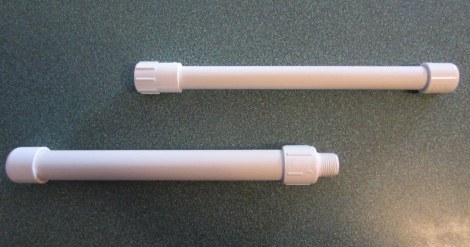
These are mostly made of PVC pipe. I picked up 10 foot lengths of 1/2 inch PVC and 3/4 inch PVC for about $1.50 each. You can make several of these fishing rods with that much PVC pipe.
First, I used a hacksaw to cut pieces of both the 1/2 inch PVC and 3/4 inch PVC that were 10 inches long. Why 10 inches? No particular reason, you can make them whatever size you want.

I used some sandpaper to smooth the edges that I had sawed and to remove the markings from the outside of the PVC pipes.

You’ll need a 3/4 inch slip cap, a 1/2 inch slip cap, a 3/4 to 1/2 threaded connector (female/male), and a 1/2 to 1/2 inch threaded connector (female/female). These fittings cost around $0.60 each.

I didn’t need to use any adhesive to get the pieces to stick together. You’ll want to be able to remove the slip caps later on anyway, since you’ll be putting you’re fishing tackle into the handles.

I drilled 3 holes all the way through the 1/2 inch PVC pipe with a 3/32 inch drill bit.

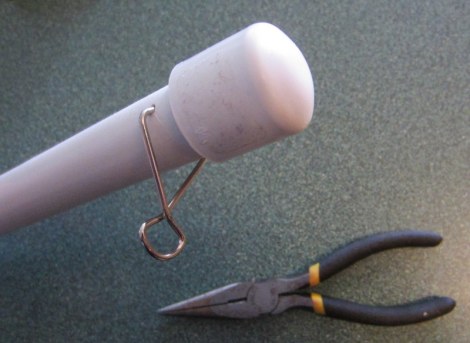
I used pieces from medium sized binder clips to make the eyelets of the fishing rod.

Remove the silver parts and use pliers to bend them until they look like the one on the right.

Then, clip it into the holes that you drilled through the 1/2 inch PVC. You’ll need to do this three times.

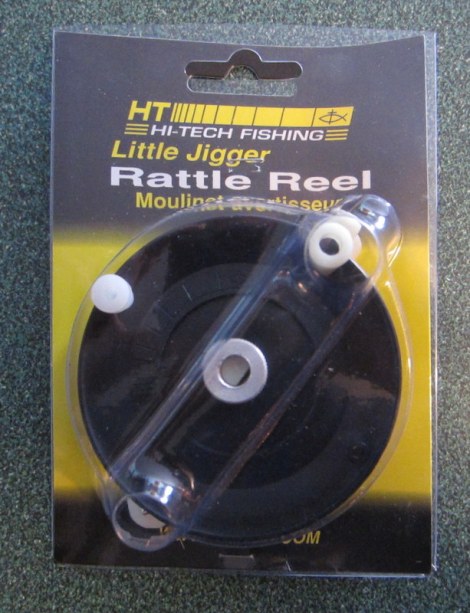
We opted to use a premade ice fishing reel because it would have been difficult for our kids to build an improvised reel. However, I’ll show you a quick way to make one after I show you how we attached these. We paid $2.96 each for the reels.

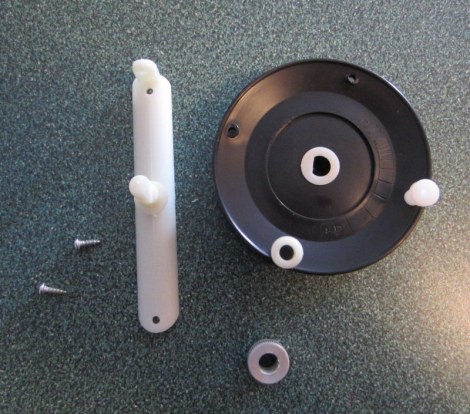
We disassembled the reels and used the white plastic piece on the left as a guide for where to drill the holes into the 3/4 inch PVC pipe.

I used the same 3/32 inch drill bit from before to make the holes and then screwed the white plastic piece into the 3/4 inch PVC.

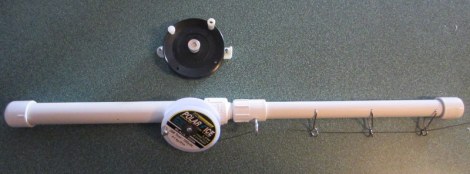
Then, you simply screw the two pieces together and you’ve got yourself a fishing rod! Don’t forget that the slip caps come off of each end, leaving you with plenty of room for storage in both sides.

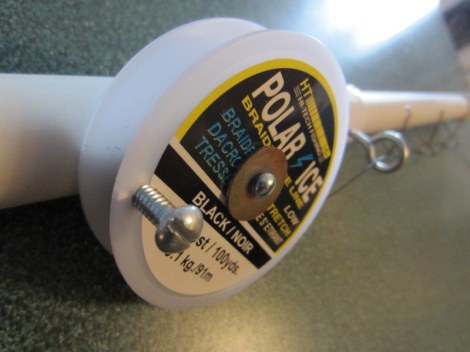
This improvised reel is made from a spool of fishing line and a few pieces of hardware. I drilled a hole into the 3/4 inch PVC with a 7/64 inch drill bit. To secure it to the rod, I simply put a screw through the center of the spool and used a washer to make it more stable. Be sure not to tighten things too much or the reel won’t spin.
I put an eye screw into the 1/2 inch PVC to act as a guide for the fishing line and threaded a bolt into the plastic part of the spool to act as a handle for the reel.

The improvised reel works okay, but the action is not as smooth as the premade one. However, it is a little bit smaller and doesn’t cost as much.

It breaks down nicely for storage. I cut some pieces from an old bike tire inner tube to band the two halves together.
All of the external pieces are removable and can be stored inside the handle with exception of the reel itself.
So, there you have it! Go have some fun and let me know how it turns out.

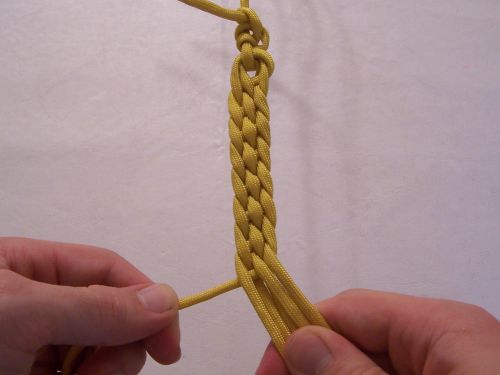
I have included two ways to make this flat braid. The first is simply the normal braiding method, and the second is more of a finger weaving method. The structure of the braid is basically the same for both methods, but because of the difference in the way tension is put on the strands, the two methods produce somewhat different looking results.
Method #1

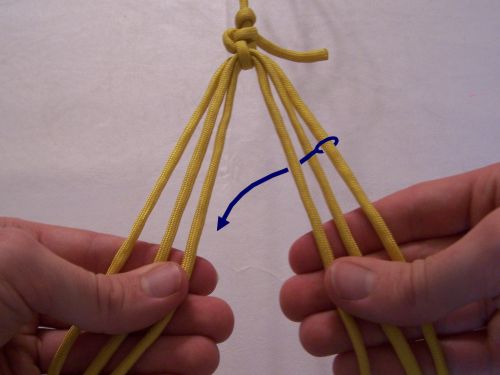
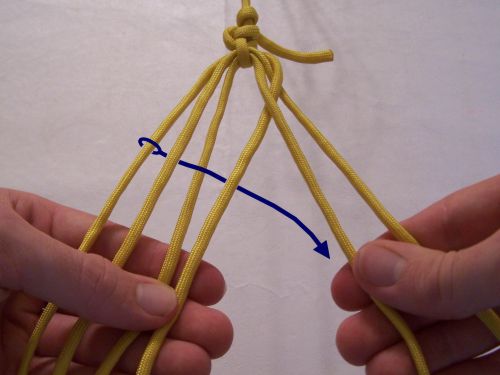
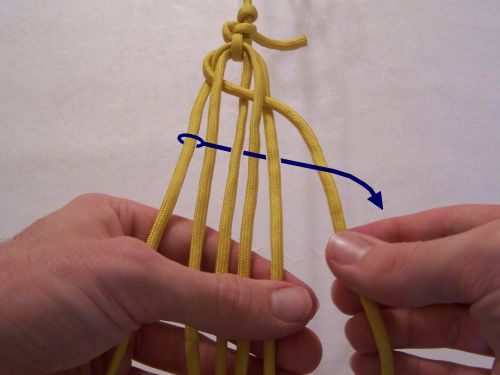
To start the braid, hold three strands in each hand. Bring the outside right-hand strand over middle right-hand strand, under the inside right-hand strand, and transfer it to the left hand as indicated by the arrow, keeping it on the inside of the other left-hand strands.

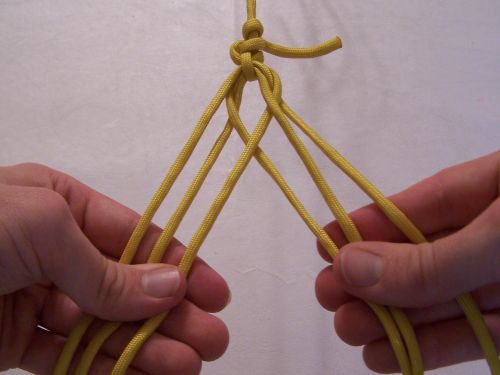
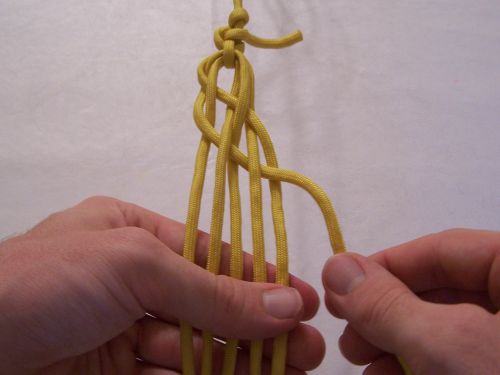
Now take the outside left-hand strand and bring it through the other three left-hand strands going under-over-under, and transfer it to the right hand, keeping it to the inside of the other right-hand strands.

Here you can see both steps have been done. These two steps are repeated for the rest of the braid.

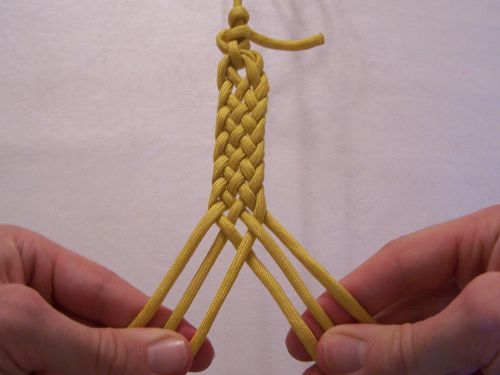
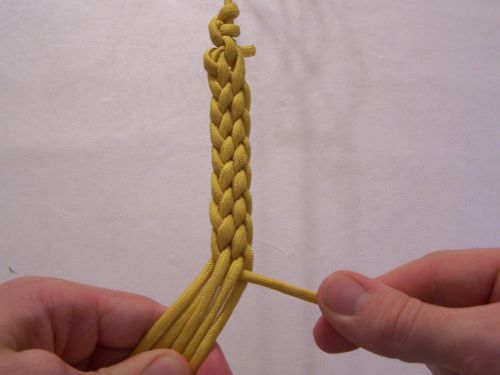
Here you can see several passes of the braid completed.
Method #2

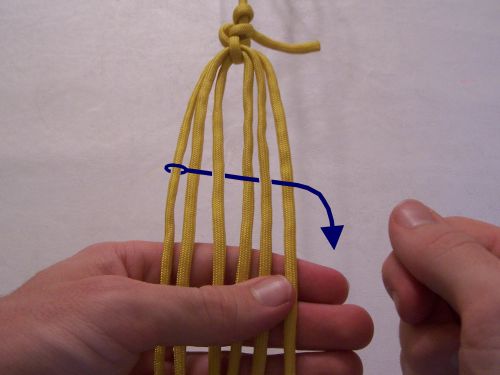
For this method, hold all six strands in the left hand. Take the farthest strand to the left and weave it through the other five strands going over-under-over-under-over, and then bring it down alongside the farthest right strand as shown by the blue arrow. It is as though the farthest left strand is used as a weft and the other strands are used as warp.

The weaving process is repteated with each strand in sequence. The strand most recently woven through becomes the farthest strand on the right, and the strand that is now the farthest on the left is the next one to be woven through.

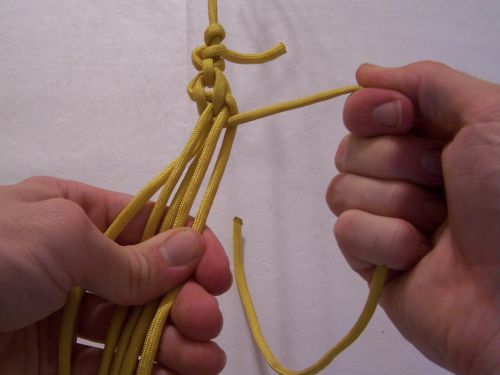
Here you can see what it looks like after two steps are done without being pulled tight.

In order to make this method work, it is necessary to pull tight on a strand after it has been woven through the others. Illustrated here is what the two completed steps look like when tightened.

Here is what the braid looks like after several more passes are completed.

Here is a view of the backside of the work.
Freeze dried foods are flash frozen and then dried.
Because their bulk and weight have been greatly reduced, dehydrated foods are more compact and convenient for storing and require very little space. They offer quick mobility in the event of an evacuation alert. For example, one case of regular canned food weighs approximately 24 pounds. The same item of dehydrated foods would weigh from 36 to 45 ounces, and would be packed in just one #10 can. Dehydrated foods have approximately double the yield of regular canned foods even though their cost is much lower.
Most of us already eat dehydrated foods daily. Foods like pasta, cereal, beans, cake and baking mixes, as well as many fast foods. In dehydrating foods, water is slowly removed by cooking it out of the food item, without cooking the food itself.
You can see how the Freeze drying process works:
Freeze drying is a process which is suitable for a wide variety of industrial products. These include agrochemicals, pharmaceutical intermediates, biological products, foods and flavorings.
The purpose of freeze drying is to remove a solvent (usually water) from dissolved or dispersed solids. It is an excellent method for preserving materials that are unstable in the presence of water. In addition, freeze drying can be used to separate and recover volatile substances and to purify materials.
The freeze drying process is particularly suitable for products which are sensitive to heat, subject to oxidation, or shear sensitive.
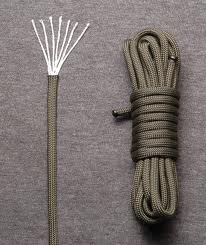
Typical nylon military spec cord is made up of 7 strands which are composed of 3 individual twisted braded lines. Civilian cord on the other hand is generally is made of 7 strands each of which are made up of two individual lines braid twisted together.
There are technically 6 different types of Military cords and all are specked to have a minimum elongation (stretch) of 30%. Only two have breaking strengths over 550 lbs…Type III and Type IV (750 lbs). Typical 550 paracord is appx 4mm or 5/32 in diameter.
Now you know the facts. If your investing in the real thing, look for the true 550 rating. Be wary of bargain “Paracords”. You may be getting decent cordage depending on your needs but more than likely will not be getting the real “550 Paracord” you were originally looking for.
You never know…your life could depend on it!
A new law proposed by the European Commission would make it illegal to “grow, reproduce or trade” any vegetable seeds that have not been “tested, approved and accepted” by a new EU bureaucracy named the “EU Plant Variety Agency.” It’s called the Plant Reproductive Material Law, and it attempts to put the government in charge of virtually all plants and seeds. Home gardeners who grow their own plants from non-regulated seeds would be considered criminals under this law.
The draft text of the law, which has already been amended several times due to a huge backlash from gardeners, is viewable here.
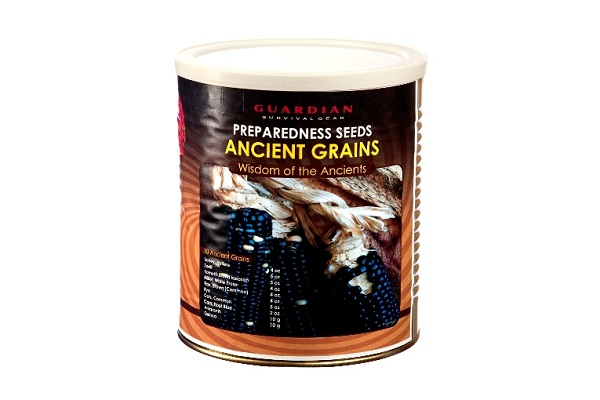
“This law will immediately stop the professional development of vegetable varieties for home gardeners, organic growers, and small-scale market farmers,” said Ben Gabel, vegetable breeder and director of The Real Seed Catalogue. “Home gardeners have really different needs – for example they grow by hand, not machine, and can’t or don’t want to use such powerful chemical sprays. There’s no way to register the varieties suitable for home use as they don’t meet the strict criteria of the Plant Variety Agency, which is only concerned about approving the sort of seed used by industrial farmers.”
All governments are, of course, infatuated with the idea of registering everybody and everything. Under Title IV of the proposed EU law:
Title IV Registration of varieties in national and Union registers
The varieties, in order to be made available on the market throughout the Union, shall be included in a national register or in the Union register via direct application procedure to the CVPO.
Gardeners must also pay fees to the EU bureaucracy for the registration of their seeds. From the proposed law text:
The competent authorities and the CPVO should charge fees for the processing of
applications, the formal and technical examinations including audits, variety denomination, and the maintenance of the varieties for each year for the duration of
the registration.
While this law may initially only be targeted at commercial gardeners, it sets a precedent to sooner or later go after home gardeners and require them to abide by the same insane regulations.
“This is an instance of bureaucracy out of control,” says Ben Gabel. “All this new law does is create a whole new raft of EU civil servants being paid to move mountains of papers round all day, while killing off the seed supply to home gardeners and interfering with the right of farmers to grow what they want. It also very worrying that they have given themselves the power to regulate and licence any plant species of any sort at all in the future – not just agricultural plants, but grasses, mosses, flowers, anything at all – without having to bring it back to the Council for a vote.”
As a hint of the level of insane bureaucracy that gardeners and vegetable growers will be subject to under this EU law, check out this language from the proposed EU law:
Specific provisions are set out on the registration in the Union variety register and with regard to the possibility for the applicant to launch an appeal against a CPVO decision. Such provisions are not laid down for the registration in the national variety
registers, because they are subject to national administrative procedures. A new obligation for each national variety examination centre to be audited by the CPVO will be introduced with the aim to ensure the quality and harmonisation of the variety registration process in the Union. The examination centre of the professional operators will be audited and approved by the national competent authorities. In case of direct application to the CPVO it will audit and approve the examination centres it uses for variety examination.
Such language is, of course, Orwellian bureaucratic speak that means only one thing: All gardeners should prepare to be subjected to total government insanity over seeds, vegetables and home gardens.
RealSeeds.co.uk warns about any attempt to actually try to understand the law by reading it:
You cannot just read the first 5 pages or so that are an ‘executive summary’, and think you know what this law is about. The executive summary is NOT what will become the law. It is the actual Articles themselves that become law, the Summary has no legal standing and is just tacked on as an aid to the public and legislators, it is supposed to give background information and set the proposed legislation in context so people know what is going on and why.
The problem with this law has always been that the Summary says lots of nice fluffy things about preserving biodiversity, simplifying legislation, making things easier etc – things we all would love – but the Articles of the law actually do completely the opposite. And the Summary is not what becomes the law.
For example, the Summary of drafts 1, 2 & 3 talked about making things easier for ‘Amateur’ varieties. But the entire class of Amateur vegetables – which we have spent 5 years working with DEFRA to register – was actually abolished entirely in the Articles right from the start. Yet the Summary , and press releases based on it, still talked about how it will help preserve Amateur varieties! The Summary is completely bogus. Do not base your views of the law on it!
So, be warned. By all means, read it yourself. But you have the ignore the Summary as that is not the Law, and does not reflect what is in the Law.
As you might suspect, this move is the “final solution” of Monsanto, DuPont and other seed-domination corporations who have long admitted their goal is the complete domination of all seeds and crops grown on the planet. By criminalizing the private growing of vegetables — thereby turning gardeners into criminals — EU bureaucrats can finally hand over full control of the food supply to powerful corporations like Monsanto.
Nearly all varieties of heirloom vegetable seeds will be criminalized under this proposed EU law. This means the act of saving seeds from one generation to the next — a cornerstone of sustainable living — will become a criminal act.
In addition, as Gabel explains, this law “…effectively kills off development of home-garden seeds in the EU.”
This is the ultimate wish of all governments, of course: To criminalize any act of self-reliance and make the population completely dependent on monopolistic corporations for their very survival. This is true both in the USA and the EU. This is what governments do: They seize control, one sector at a time, year after year, until you are living as nothing more than a total slave under a globalist dictatorial regime.
An online petition has already been started on this issue and has garnered nearly 25,000 signatures so far.
NOAH’S ARK and 240 other organizations from 40 European countries have also initiated an “open letter” appealing to Brussels bureaucrats to stop the insanity. Click here for a translated version of their petition.
By the way, I am on the record predicting this exact scenario. Read Chapter Three of my fiction book, “Freedom Chronicles 2026.” (Read it FREE, online.) It depicts a seed smuggler living in a time when seeds are criminalized and people earn a living as professional seed smugglers.
In my book, a woman uses a specially-crafted breast prosthesis to smuggle seeds to “underground gardeners” in full defiance of laws crafted by Monsanto. A vast underground network of grassroots gardeners and scientists manage to put together a “seed weapon” to destroy GMOs and take back the food supply from evil corporations.
Mark my words: Seeds are about to become contraband. Anyone who grows their own food is about to be targeted as a criminal. The governments of the world, conspiring with corporations like Monsanto, do not want any individual to be able to grow their own food.
This is about total domination of the food supply and the criminalizing of gardeners. And this is what big government always does after centralizing sufficient power. All governments inherently seek total control over the lives of everyone, and if you don’t set boundaries and limits for government (i.e. the Bill of Rights), it eventually runs roughshod over all freedoms and liberties, including the freedom to grow your own food.
Additional sources:
http://open-seeds.org/bad-seed-law/
http://www.realseeds.co.uk/seedlaw.html
Learn more: http://www.naturalnews.com/040214_seeds_european_commission_registration.html#ixzz2SoEzRpHN

Unless you have deep pockets, and most people don’t, you are going to have to purchase and store your prepping supplies a little at a time. When your at the store buying clothes for your kids, pick up a pack of batteries. When you are out picking up dinner at the grocery store, don’t forget to grab a couple of cans of soup. You get the picture.

With all this in mind, here is a list of items that you can start buying when your out and about to add to your prepping supplies that will cost you right around 5 bucks. You would be surprised at how much stuff you can amass when you think to pick up a few extra things a few times a week.
Add in some Aldi coupon codes and your entire grocery bill will shrink, allowing you to save money or get extra supplies.
(Note: This list comes from other posts and articles of read over time with a couple of items I have added from my own experience. If you have got any suggestions, please leave a comment and share your knowledge. )
(Note: I’m aware that the dollar has been devalued such that some items on this list may now far exceed the 5 dollar limit. Adjust quantities accordingly.)
A bug-out-bag is a must-have for any savvy survivalist. When an emergency occurs that requires evacuating, it keeps you prepared while you’re on-the-go. This portable kit is designed to help you survive an evacuation for three days. Some people refer to it as a 72-hour kit. The three main characteristics of a good bug-out-bag are:

Depending on the type of survivalist you are, you may choose to alter this list a bit. These are just my suggestions, as one survivalist to another:
1. Water – Experts recommend packing at least one gallon of water, per person, per day. However, that’s a lot of weight to tote around. Most savvy survivalists prefer other options for clean water, such as:
2. Non-Perishable Foods – If you’re a fan of dehydrated foods, you’ll also need to pack a portable stove to prepare your meals. Canned foods require no cooking for healthy consumption. However, these food item are extremely heavy to carry. On the other hand, freeze dried foods are prepared in minutes by simply adding hot water. They’re also very lightweight to tote around.
3. First Aid Kit – Remember that you want to keep your bug-out-bag as lightweight as possible. So, only pack the basic essentials:
4. Clothing – Pack enough to hold you over for three days. Be sure to include a thick coat and strong shoes/boots, as well extra pairs of thick socks.
5. Shelter – This can be a tent, tarp, fly, large poncho, hammock with rain fly, or anything a savvy survivalist can use to create an emergency shelter.
6. Important Documents – Keep a file folder containing documents such as passports, birth certificates, copies of IDs, list of important phone numbers, maps, evacuation routes and stations, etc…
7. Hard Cash – Will need it for survival, as electrical, banking, credit card processing and ATM machines services may be done indefinitely.
8. Gun & Ammunition – Depending on where you choose to evacuate to, you may need to hunt for food. Will also come in handy for protection, especially if you end up sleeping outside.
9. Battery Operated Radio – Who knows where you’ll end up after being evacuated. Your radio will keep you informed on updated evacuation news. It may also be your only source of entertainment with no television access.
10. Survival Kit – Should include essentials such as:
Author Bio: This article was written by fellow survivalist, Chett Wright for FoodInsurance.com. Looking for a high quality bug-out-bag or 72-hour kit? Click here to see the emergency supplies Food Insurance has to offer.