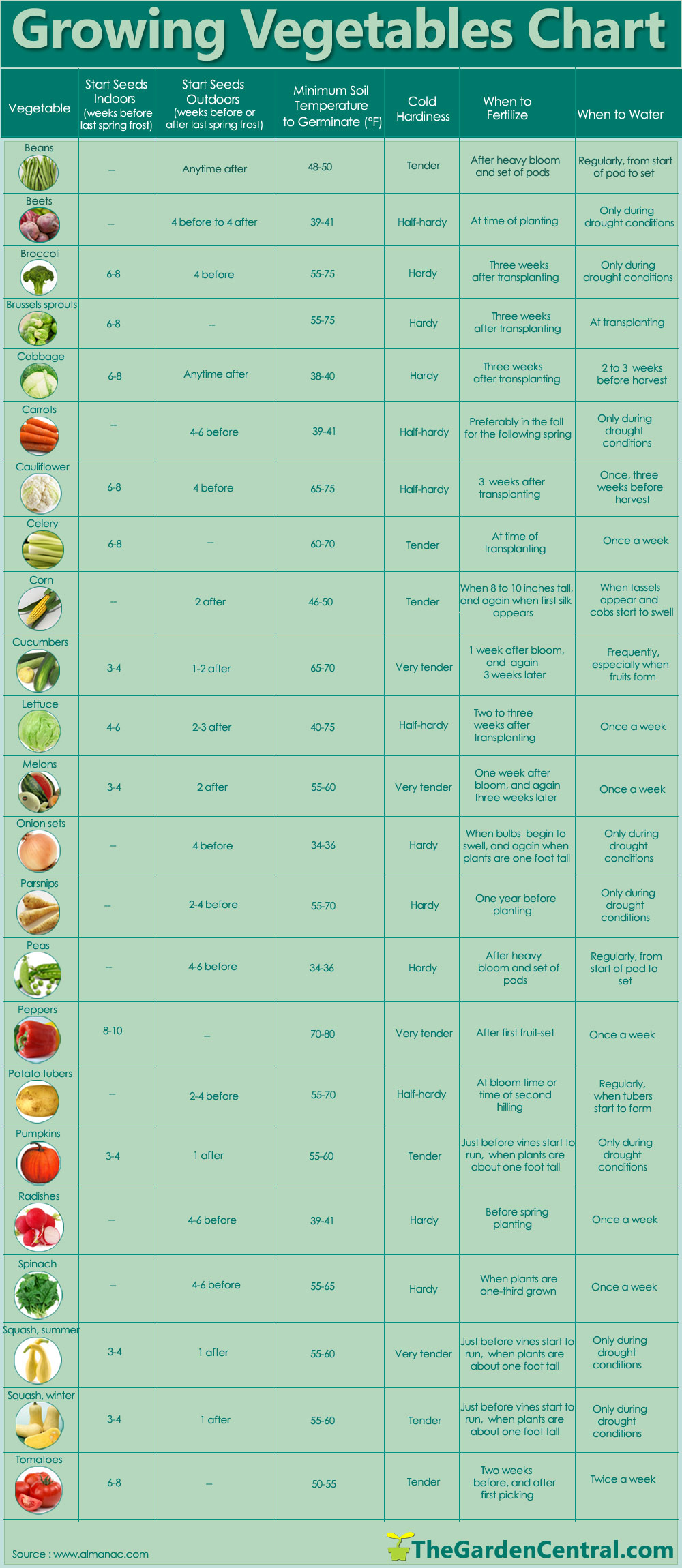
Knowing what to do and when to plant is critical. This handy chart gives you the guidelines to planting your own vegetables. Good information to create your own survival garden.

Knowing what to do and when to plant is critical. This handy chart gives you the guidelines to planting your own vegetables. Good information to create your own survival garden.

In my experience, while the power company spends its energies hooking up more important buildings like schools and hospitals, I spend at least the first day in the dark. That means encouraging my family to eat ice cream before it melts and cooking hot dogs over a fire. The fridge’s cold air is fading fast and it can only be opened on a strict schedule: whenever every member of the family is simultaneously dying of hunger. By the second day, the refrigerator’s cooling powers have failed entirely. The now useless box begins to stink of rot and breakfast is served at the doughnut store. In fact, every meal is either pizza or donuts until the electric company decides to grace my street with their omnipotent presence. Although a power outage is a kid’s culinary dream, it can be an adult’s nightmare.

Yet, with a little knowledge and planning, you can actually cook delicious meals without a refrigerator. After living on boats for almost four years with no or limited electricity, I have learned it is possible to eat like a gourmet without ice.
Please use your own judgement when consuming any food. These are techniques the author has found useful. The author is not liable for any illnesses you may experience due to eating non refrigerated food.
Source: Off The Blueprint


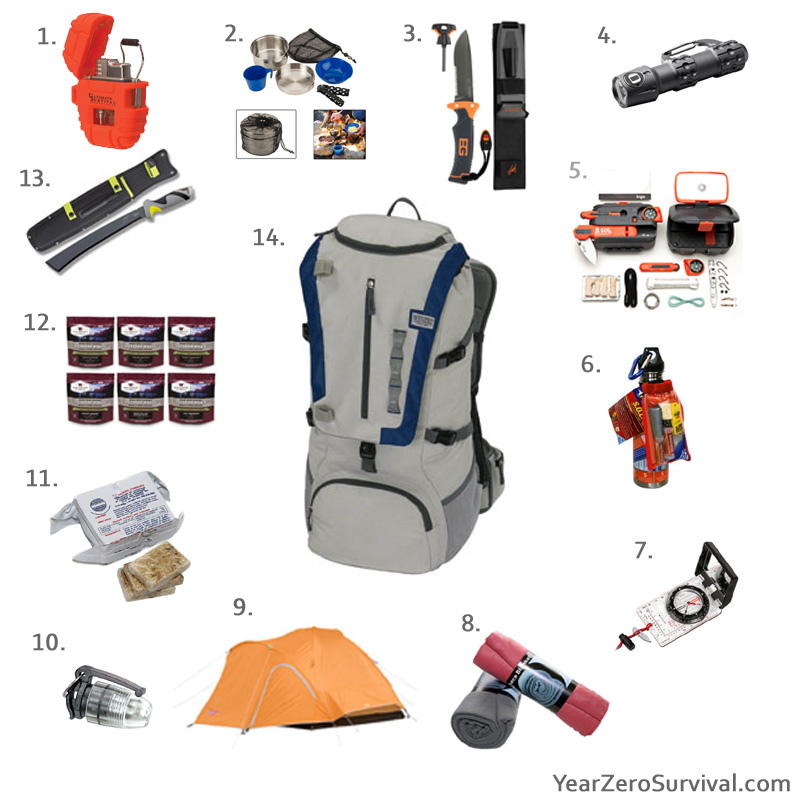
This is one illustration of the items you could consider for your own Bug-Out bag. We also carry pre-made Bug-Out bags ready when you are. Depending on your location and situation, you may want to add or delete items suggested here.
Bear in mind, this pack has all the elements to last you longer than 72 hours, with the exception of the food items, and your ability to find a source of water.
What would you add or remove from yours?

When Hurricane or “Super Storm” Sandy hit here last autumn, I didn’t have power for eleven days. I was one of the lucky ones, though — I still had my house, a gas-powered stove, and gas-heated water. Here’s what I learned about living without electricity.
Light
Refrigeration & Cooking

Temperature Control
The worst part of a power outage in the late fall and winter months is losing your heat. A fireplace helps, but burning logs isn’t enough. Unless you’re already in an enclosed space, the warm air is going to be sucked away. To avoid this, you can create a temporarily enclosed space, for example by using some good tape and a few plastic painter’s drop sheets. If you manage to get your fireplace and stove into the same space, it helps to boil some water and steam up the room a little. However, it’s not wise to run gas heat in an enclosed space for long (and a gas fireplace shouldn’t be enclosed at all). Also, the steam will eventually soften up your walls.
Keeping Cool During a Summer Power Outage
Connectivity

Staying Positive
Source: Off The Blueprint
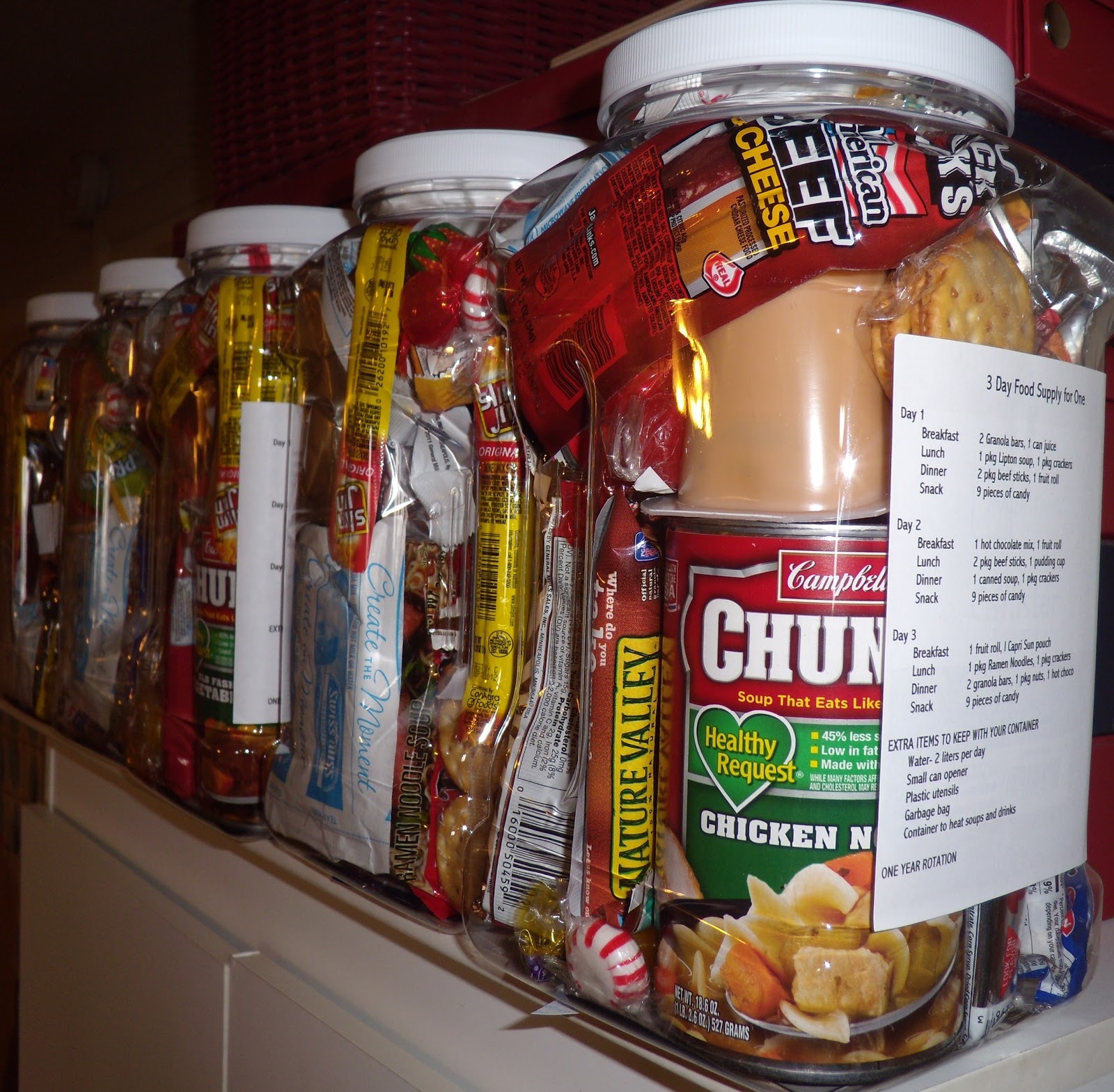
You never know when some sort of disaster might happen, but you can be ready. Please note that this is only a 72 hour supply, so I like to put in some comfort foods, this is in no way similar to my longer term food storage, which is geared to a longer survival period.
MATERIALS:
One gallon plastic food container per kit (it is very hard to fit all the food into the container so I planned on using 1 gallon zip lock bags) Also added a couple of Oxygen Absorbers in each container for good measure.
Food items on the menu:
3 Day Food Supply for One
Shove the food into the container as best you can and store with your backpack or 72 hour kit.
Some food items last longer than others. Related: Shelf life of food.
Tip: If you use mints keep them in a separate baggie or they will make your crackers taste like mint. GOOD TO KNOW!
This “menu” is purely an example. You can put in your jar what ever you want. Food preferences and choices are and should be up to the individual making the kit. I realize lot of you might disagree with the food choices I have used, but it is my choice, you pack yours the way you want, with MREs and long-term food storage items.
Over the past 70 years of its existence, this staple product of fix-it-your-selfers has been used by virtually every walk of life, for jobs that I’m sure the duct tape developers never imagined. So how can we use it for survival?

Here are 25 survival uses for duct tape, in no order whatsoever.
1. Repairing a cracked water bottle or a pierced hydration bladder. A little strip of DT is the next best thing to a bandage for an ailing water vessel. Just dry the surface before you try to tape your patch in place, most forms of duct tape don’t stick to wet surfaces.
2. Survival arrow fletching. Tear off a few 5-inch pieces, and a long edge of one piece to the arrow shaft, fold the tape lengthwise, and stick the other long edge of that piece to the arrow. Repeat this process one or two more times; trim the vanes to shape with your knife; and you will have a serviceable arrow fletching.
3. Butterfly bandage strips. Cut two small strips of DT, and add a smaller strip across their centers (sticky side to sticky side) to create a makeshift butterfly suture.
4. Make cordage. Twist one or several lengths of duct tape into a cord or rope.
5. Patch a hole in canoe. I wouldn’t trust my life to this one, but it’s been done more than once.
6. Fashion a belt. When you are starving in the wild, and your pants start falling down, run a piece of DT through your belt loops and stick it to itself in the front. Overlap it about 4 or 5 inches and you’ll still be able to peel the belt apart when nature calls.
7. First aid sling. Fold a length of DT down the middle, so that it is half the original width and no longer exposing a sticky side. Use the strap to make a sling for a busted arm.
8. Leave a note. Write on it with a Sharpie, or use strips to form letters.
9. Handcuff alternative. If someone is acting up during a survival emergency, you can duct tape their hands together around a tree to prevent them from becoming a danger to themselves or others.
10. Mend shoes and clothing. You can skip the sewing class, if you have enough duct tape.
11. Repair your glasses. The tape on your glasses my look a little nerdy, but at least you’ll still be able to see.
12. Attach shelter elements. Just a few trash bags and some duct tape, and you have a survival shelter roof, or a sleeping bag cover, or a wind break, or…
13. Attach survival gear. Tape a spark rod to the side of your knife sheath, and you’ll always have a back-up fire source.
14. Make a hat. If you believe what you see on TV, the “Mythbusters” guys made a pretty nice looking hat out of duct tape on a recent episode.
15. Afix bandages. Place a sterile dressing over your wound, and strap it in place with DT. Hopefully you’re not too hairy where you got injured.
16. Fix your rain gear. Keep the dry stuff dry, and keep the water out, by mending your ripped rain gear with a few strips.
17. Make a drinking cup. Some creative folding and sticking can result in a cup you can drink from.

18. Make a spear. Strap your knife to a pole and you have a trusty spear to fend off beasts, or make one into your dinner.
19. Blister care. Cover the blistered area with a bit of cotton gauze, and tape over the cotton. Make sure that the duct tape fully covers the cotton and doesn’t touch the blister at all.
20. Mark a Trail. Use it to blaze a trail or signal for rescue, especially if your DT is brightly colored or reflective.
21. Make emergency repairs on your Bug Out Vehicle. Leaking hoses and windows that won’t stay up don’t stand a chance against the mending powers of duct tape.
22. Keep the feathers in your sleeping bag. If you have a hole in your down sleeping bag, the feathers will pour out faster than excuses from a politician. Patch the hole with DT.
23. Keep your tent closed. A damaged zipper could leave your tent door flapping in the wind. Stick the door shut, and keep the bugs and critters out.
24. Splint a leg. A broken ankle or leg can be stabilized with ample splint material, padding and duct tape. Pad the crotch of a forked branch with some cloth and duct tape to fashion a quick crutch to go with your splint.
25. Splint a broken tent pole or fishing pole. By taping a stick to the broken area of your tent pole or fishing rod, you might just get one last adventure out of it.
Tell us your best duct tape trick or survival strategy in the comments.